


Macrorhizodus nolfi
Zhelezko, 1999
Classification: Elasmobranchii Lamniformes Lamnidae
Reference of the original description
Elasmobranhii i biostratigraphia paleogena Zauralia i Srednei Asii. (Elasmobranchii and Palaeogene biostratigraphy of Transural and Central Asia). Materialy po Stratigrafii i Paleontologii Urala, 3, 324 pp, Ekaterinburg, UrO RAN
Elasmobranhii i biostratigraphia paleogena Zauralia i Srednei Asii. (Elasmobranchii and Palaeogene biostratigraphy of Transural and Central Asia). Materialy po Stratigrafii i Paleontologii Urala, 3, 324 pp, Ekaterinburg, UrO RAN
Synonyms / new combinations and misspellings
Macrorhizodus cf. nolfi
Macrorhizodus cf. nolfi
Types
Macrorhizodus nolfi
Holotype: Darwin Museum: GIK No. 15478/41; Paratype: Darwin Museum: GIK No. 15478/42-45;
Macrorhizodus nolfi
Holotype: Darwin Museum: GIK No. 15478/41; Paratype: Darwin Museum: GIK No. 15478/42-45;
Description:
Citation: Macrorhizodus nolfi Zhelezko, 1999: In: Database of fossil elasmobranch teeth www.shark-references.com, World Wide Web electronic publication, Version 09/2026
Please send your images of "Macrorhizodus nolfi" to info@shark-references.com
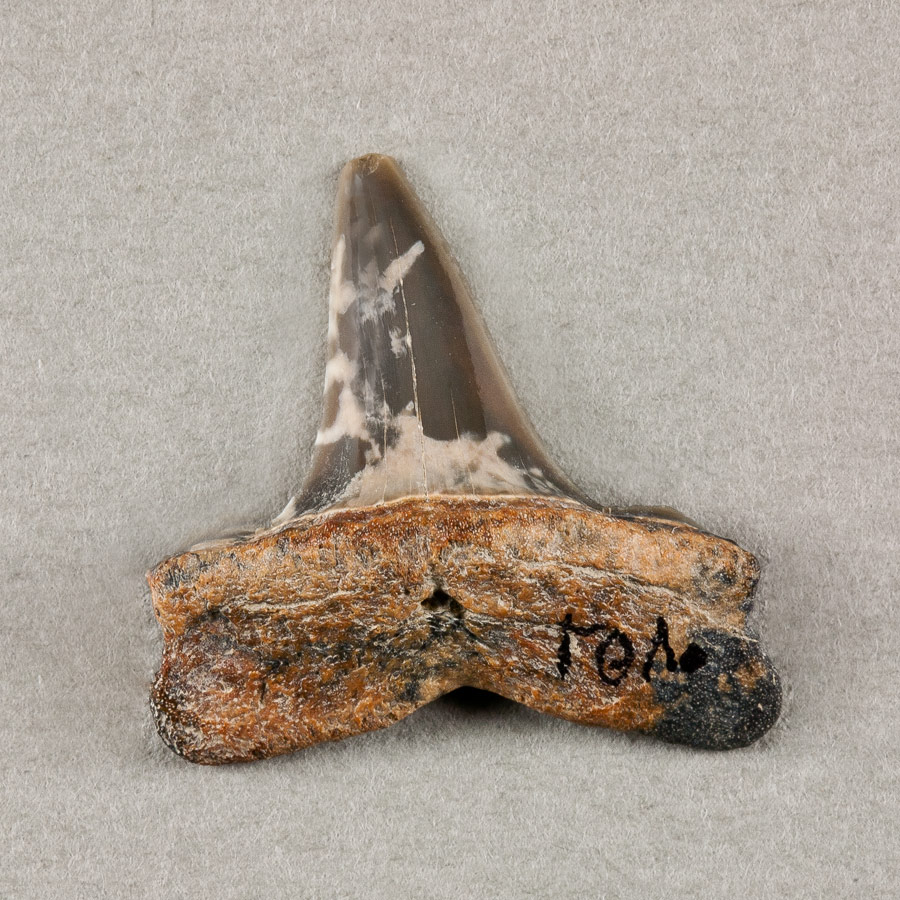
Macrorhizodus nolfi Zhelezko, 1999, lingual view, Holotype GIK No. 15478/41 © State Darwin Museum, Moscow
Macrorhizodus nolfi Zhelezko, 1999, lingual view, Holotype GIK No. 15478/41 © State Darwin Museum, Moscow
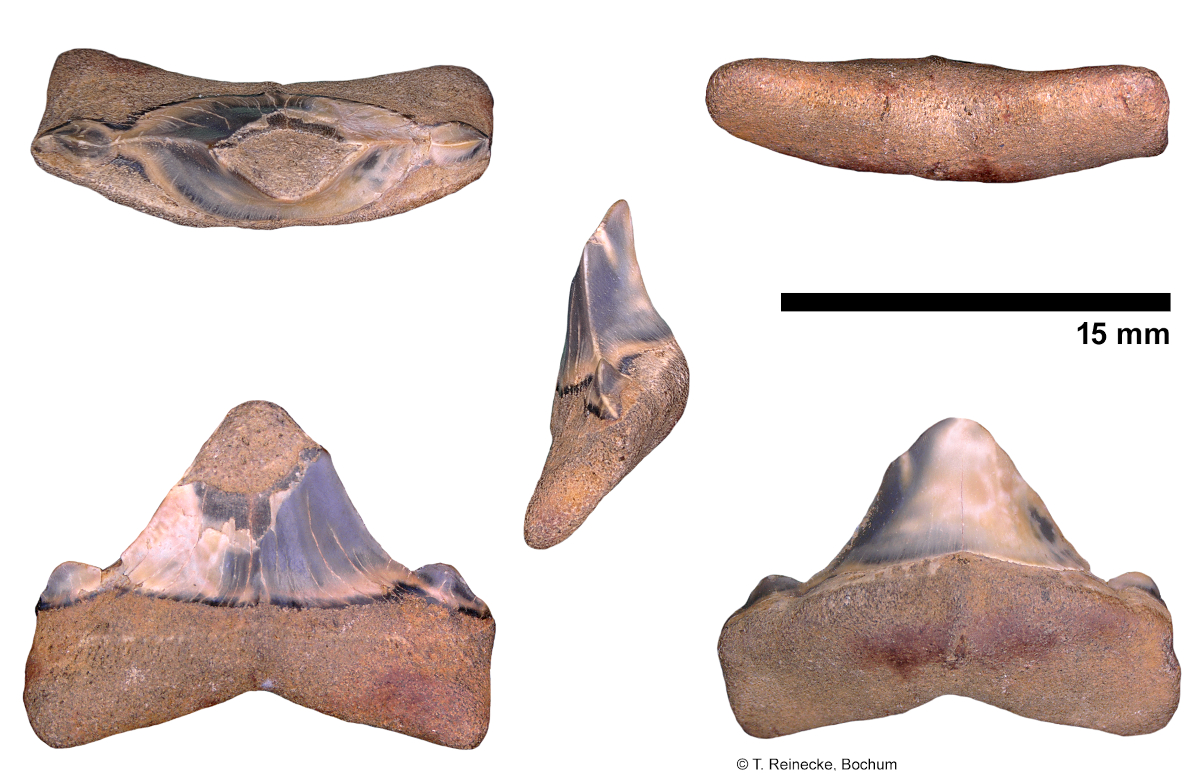
Description
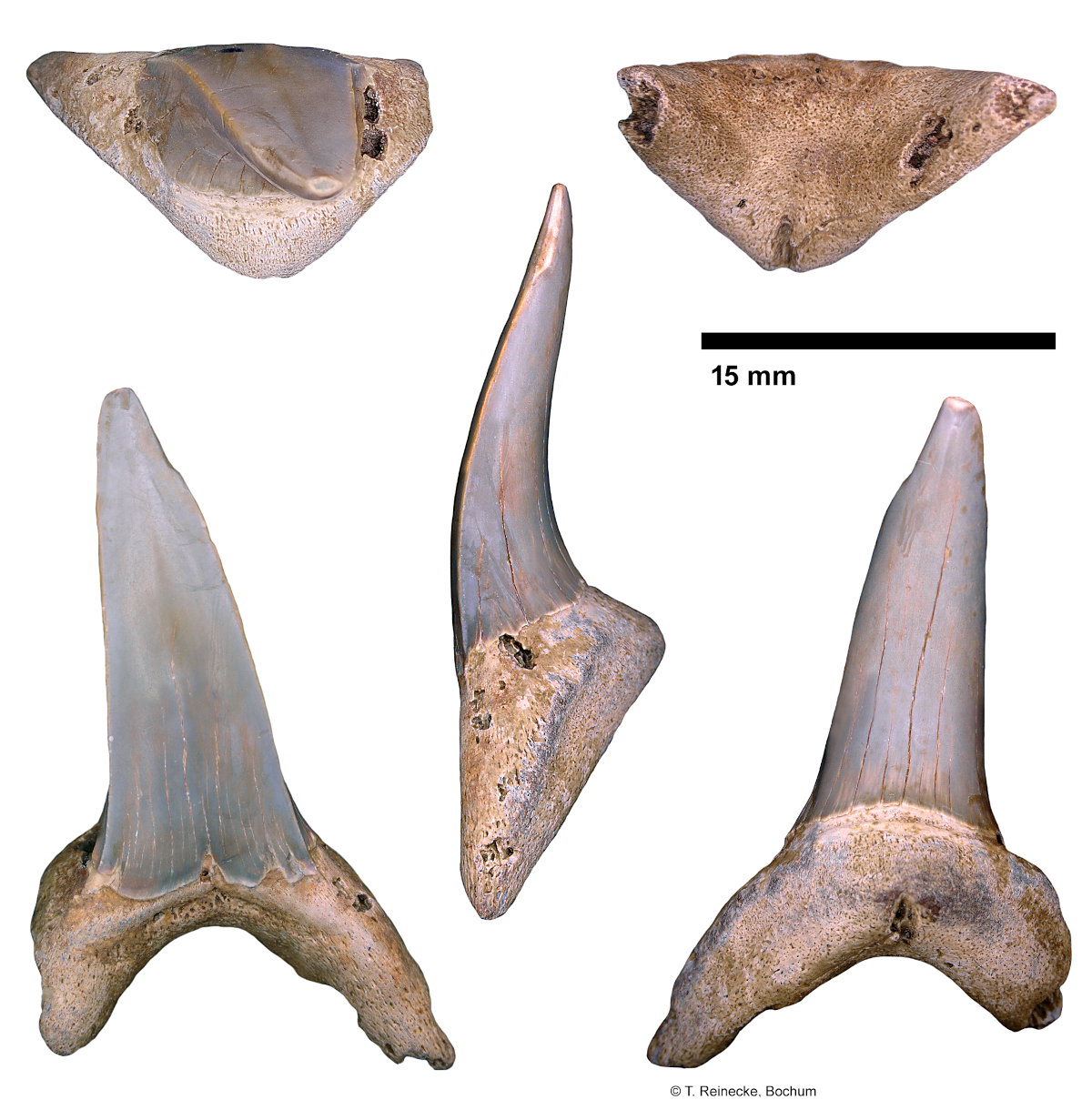
Original diagnosis after Zhelezko, 1999 [2658] (translated from russian via AI): Dental apparatus of tearing-cutting type. Roots of anterior teeth arched, moderately thick; root branches rounded, of medium length, tapered at the ends. Central protuberance low, gradually transitioning to the weakly convex surface of the branches. Lateral cusplets small, spiniform, often reduced.
Roots of lateral and posterior teeth of upper and lower jaws flat or with a low arch; central protuberance not pronounced. Branches wide, flat on the inner side. Crowns cutting, in overall shape approaching an isosceles triangle.
Lateral denticles numbering one or two pairs, triangular-blade-like, on many teeth with clearly pronounced signs of reduction. Denticles confluent-accessory (fused-adnate). Isthmus (bridge) narrow, constricted. Cutting edge as a rule uninterrupted (not broken).
Original diagnosis after Zhelezko, 1999 [2658] (translated from russian via AI): Dental apparatus of tearing-cutting type. Roots of anterior teeth arched, moderately thick; root branches rounded, of medium length, tapered at the ends. Central protuberance low, gradually transitioning to the weakly convex surface of the branches. Lateral cusplets small, spiniform, often reduced.
Roots of lateral and posterior teeth of upper and lower jaws flat or with a low arch; central protuberance not pronounced. Branches wide, flat on the inner side. Crowns cutting, in overall shape approaching an isosceles triangle.
Lateral denticles numbering one or two pairs, triangular-blade-like, on many teeth with clearly pronounced signs of reduction. Denticles confluent-accessory (fused-adnate). Isthmus (bridge) narrow, constricted. Cutting edge as a rule uninterrupted (not broken).
Image gallery
References

Fossile hajtaender fra Trelde Naes. Self-published

Feeding ecology has shaped the evolution of modern sharks. Current Biology, 31(23), 5138–5148
DOI: 10.1016/j.cub.2021.09.028
Climate cooling and clade competition likely drove the decline of lamniform sharks. Proceedings of the National Academy of Sciences of the United States of America, 116(41), 20584–20590
DOI: 10.1073/pnas.1902693116
The Turanian Basin in the Eocene: the new data on the fossil sharks and rays from the Kyzylkum Desert (Uzbekistan). Proceedings of the Zoological Institute, Russian Academy of Sciences, 320(1), 50–65
A study of the sharks and rays from the Lillebælt Clay (Early–Middle Eocene) of Denmark, and their palaeoecology. Bulletin of the Geological Society of Denmark, 62, 39–88
DOI: 10.37570/bgsd-2014-62-04
The Aktulagay section, west Kazakhstan: a key site fornorthern mid-latitude Early Eocene stratigraphy. Stratigraphy, 10(3): 171–209
London Clay Fossils of Kent and Essex. Rochester, Kent, Medway Fossil and Mineral Society, 228 p, ISBN: 978–0–9538243–1–1
Elasmobranhii i biostratigraphia paleogena Zauralia i Srednei Asii. (Elasmobranchii and Palaeogene biostratigraphy of Transural and Central Asia). Materialy po Stratigrafii i Paleontologii Urala, 3, 324 pp, Ekaterinburg, UrO RAN
Fossile hajtaender fra Trelde Naes. Self-published
Feeding ecology has shaped the evolution of modern sharks. Current Biology, 31(23), 5138–5148
DOI: 10.1016/j.cub.2021.09.028
Climate cooling and clade competition likely drove the decline of lamniform sharks. Proceedings of the National Academy of Sciences of the United States of America, 116(41), 20584–20590
DOI: 10.1073/pnas.1902693116
The Turanian Basin in the Eocene: the new data on the fossil sharks and rays from the Kyzylkum Desert (Uzbekistan). Proceedings of the Zoological Institute, Russian Academy of Sciences, 320(1), 50–65
A study of the sharks and rays from the Lillebælt Clay (Early–Middle Eocene) of Denmark, and their palaeoecology. Bulletin of the Geological Society of Denmark, 62, 39–88
DOI: 10.37570/bgsd-2014-62-04
The Aktulagay section, west Kazakhstan: a key site fornorthern mid-latitude Early Eocene stratigraphy. Stratigraphy, 10(3): 171–209
London Clay Fossils of Kent and Essex. Rochester, Kent, Medway Fossil and Mineral Society, 228 p, ISBN: 978–0–9538243–1–1
Elasmobranhii i biostratigraphia paleogena Zauralia i Srednei Asii. (Elasmobranchii and Palaeogene biostratigraphy of Transural and Central Asia). Materialy po Stratigrafii i Paleontologii Urala, 3, 324 pp, Ekaterinburg, UrO RAN