


 Catalog of Fishes
 literature references
 FishBase
 NCBI GenBank
Etmopterus bulbosus
Ebert, Leslie, Bogorodsky, Sithole, Kaully, Seetohul & van Staden, 2026
Classification: Elasmobranchii Squaliformes Etmopteridae
Reference of the original description
Etmopterus bulbosus, a new lanternshark (Squaliformes: Etmopteridae) from the southwestern Indian Ocean. Journal of the Ocean Science Foundation, 47, 8–23
Etmopterus bulbosus, a new lanternshark (Squaliformes: Etmopteridae) from the southwestern Indian Ocean. Journal of the Ocean Science Foundation, 47, 8–23
Images of types
Description :
Citation: Etmopterus bulbosus Ebert, Leslie, Bogorodsky, Sithole, Kaully, Seetohul & van Staden, 2026: In: Database of modern sharks, rays and chimaeras, www.shark-references.com, World Wide Web electronic publication, Version 10/2026
Please send your images of "Etmopterus bulbosus" to info@shark-references.com
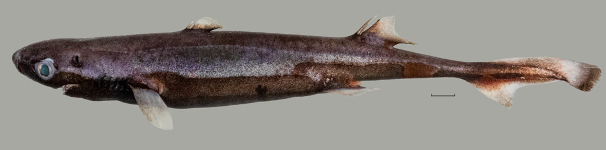
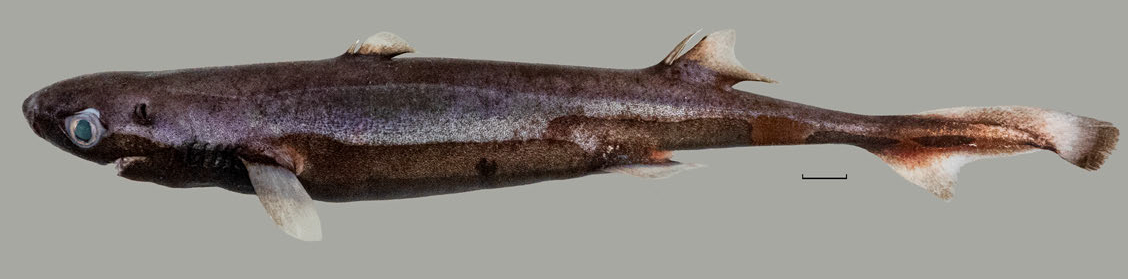
Etmopterus bulbosus Ebert, Leslie, Bogorodsky, Sithole, Kaully, Seetohul & van Staden, 2026; fresh holotype, SAIAB 214299, female, 215 mm TL, Mauritius, bar=10 mm (S.V. Bogorodsky).
Etmopterus bulbosus Ebert, Leslie, Bogorodsky, Sithole, Kaully, Seetohul & van Staden, 2026; fresh holotype, SAIAB 214299, female, 215 mm TL, Mauritius, bar=10 mm (S.V. Bogorodsky).
Common names
 Big-nosed Lanternshark
Big-nosed Lanternshark
Short Description
Diagnosis after Ebert, Leslie, Bogorodsky, Sithole, Kaully, Seetohul & van Staden, 2026 [36344]: A relatively small species of Etmopterus, distinguished by a firm, fusiform, nearly cylindrical body with a subconical bulbous snout and a distinct patch of enlarged, thorn-like, dermal denticles above pectoral-fin axil, extending vertically from lateral dark luminescent markings to dorsal midline of back and posteriorly to beyond first-dorsal-fin free-rear tip; distinct lateral flank markings with a short and thick anterior branch and a truncated posterior branch, followed by a strongly demarcated, dark-brown, lateral marking extending to origin of caudal-base marking; caudal-fin-base marking elongated, extending anteriorly along caudal peduncle to just posterior to second dorsal free-rear tip; upper body purplish, ventral body surface uniform black from snout to cloaca; tooth count in first row of upper jaw 19 and in first row of lower jaw 29 (14-1-14); total vertebrae 78+; total precaudal vertebrae 53 with 34 monospondylous and 19 diplospondylous, caudal vertebrae 25+.
Diagnosis after Ebert, Leslie, Bogorodsky, Sithole, Kaully, Seetohul & van Staden, 2026 [36344]: A relatively small species of Etmopterus, distinguished by a firm, fusiform, nearly cylindrical body with a subconical bulbous snout and a distinct patch of enlarged, thorn-like, dermal denticles above pectoral-fin axil, extending vertically from lateral dark luminescent markings to dorsal midline of back and posteriorly to beyond first-dorsal-fin free-rear tip; distinct lateral flank markings with a short and thick anterior branch and a truncated posterior branch, followed by a strongly demarcated, dark-brown, lateral marking extending to origin of caudal-base marking; caudal-fin-base marking elongated, extending anteriorly along caudal peduncle to just posterior to second dorsal free-rear tip; upper body purplish, ventral body surface uniform black from snout to cloaca; tooth count in first row of upper jaw 19 and in first row of lower jaw 29 (14-1-14); total vertebrae 78+; total precaudal vertebrae 53 with 34 monospondylous and 19 diplospondylous, caudal vertebrae 25+.
Dentition
Teeth dissimilar in upper and lower jaw; upper teeth erect, multicuspid in two functional series, functional teeth in lower jaw unicuspid in a single series, with at least two series of replacement teeth in upper and lower jaw; multicuspid upper teeth small, perpendicular, slightly curved, with a strong, slender, central cusp flanked by two lateral cusplets on each side, decreasing in size laterally; first lateral cusplet about one-half height of central cusp, second lateral tooth cusplet reduced; teeth in lower jaw fused into a single row, blade-like, cusp oblique, semi-erect. Tooth count in first row of upper jaw 19 and in first row of lower jaw 29 (14-1-14). [36344]
Teeth dissimilar in upper and lower jaw; upper teeth erect, multicuspid in two functional series, functional teeth in lower jaw unicuspid in a single series, with at least two series of replacement teeth in upper and lower jaw; multicuspid upper teeth small, perpendicular, slightly curved, with a strong, slender, central cusp flanked by two lateral cusplets on each side, decreasing in size laterally; first lateral cusplet about one-half height of central cusp, second lateral tooth cusplet reduced; teeth in lower jaw fused into a single row, blade-like, cusp oblique, semi-erect. Tooth count in first row of upper jaw 19 and in first row of lower jaw 29 (14-1-14). [36344]
Remarks
shark-references Species-ID=17942
shark-references Species-ID=17942