


 Catalog of Fishes
 literature references
 FishBase
 NCBI GenBank
Echinorhinus roinee
Bineesh, Rozario, Akhilesh & Banerjee, 2026
Classification: Elasmobranchii Echinorhiniformes Echinorhinidae
Reference of the original description
Echinorhinus roinee, a New Species of Bramble shark (Echinorhiniformes: Echinorhinidae) from the Southwestern Coast of India.
Echinorhinus roinee, a New Species of Bramble shark (Echinorhiniformes: Echinorhinidae) from the Southwestern Coast of India.
Types
Echinorhinus roinee
Holotype: ZSI: MBRC/F/3584; Paratype: ZSI: MBRC/F/3586; ZSI: MBRC/F/3062/1; ZSI: MBRC/F/3062/2;
Echinorhinus roinee
Holotype: ZSI: MBRC/F/3584; Paratype: ZSI: MBRC/F/3586; ZSI: MBRC/F/3062/1; ZSI: MBRC/F/3062/2;
Images of types
Description :
Citation: Echinorhinus roinee Bineesh, Rozario, Akhilesh & Banerjee, 2026: In: Database of modern sharks, rays and chimaeras, www.shark-references.com, World Wide Web electronic publication, Version 11/2026
Please send your images of "Echinorhinus roinee" to info@shark-references.com
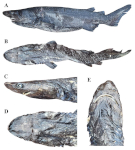
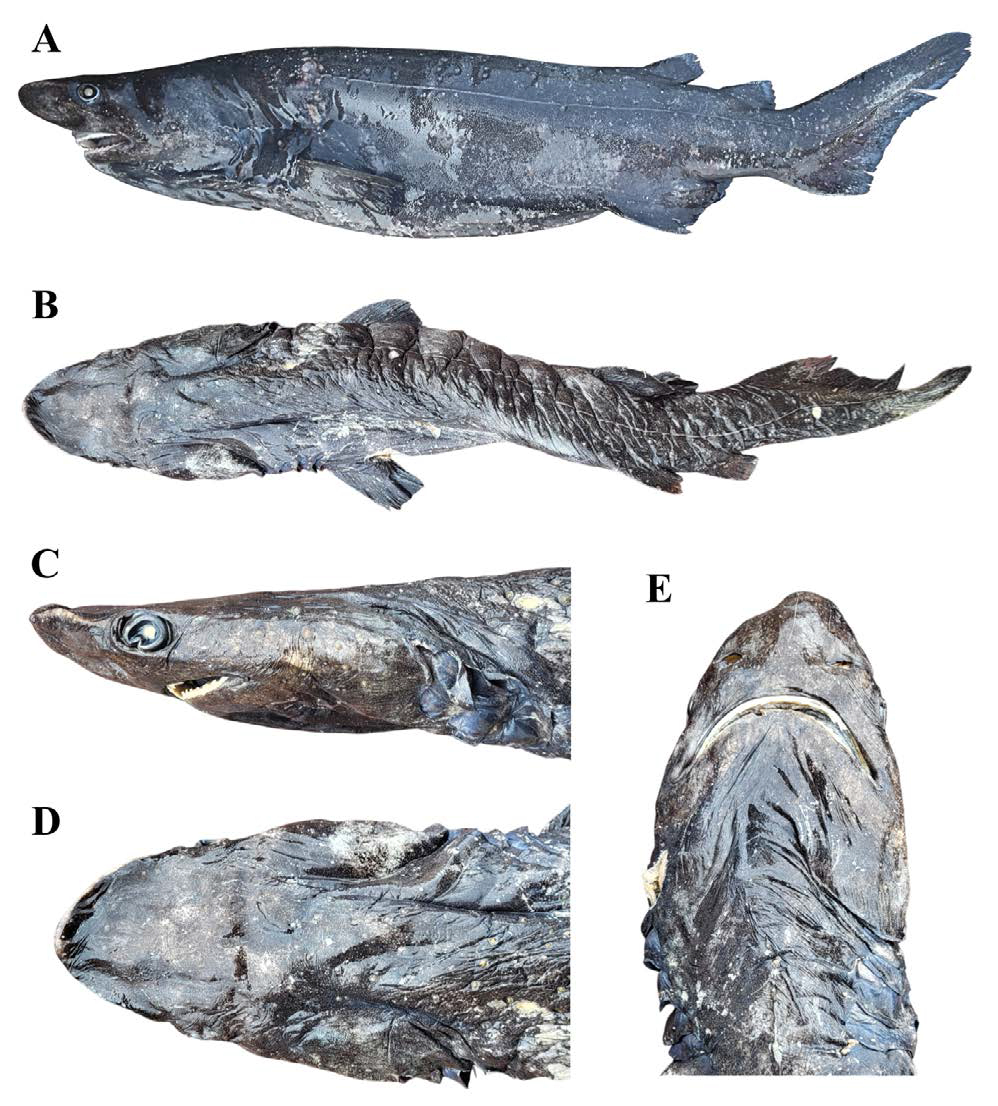
Echinorhinus roinee Rozario, Bineesh, Beura, Akhilesh, Kasinath & Banerjee, 2026; holotype, Regd. No. MBRCF 3584, female, 1095 mm TL, Kollam, southwest coast of India, 350-450 m depth © by the authors
Echinorhinus roinee Rozario, Bineesh, Beura, Akhilesh, Kasinath & Banerjee, 2026; holotype, Regd. No. MBRCF 3584, female, 1095 mm TL, Kollam, southwest coast of India, 350-450 m depth © by the authors
Common names
Indian Bramble shark
Indian Bramble shark
Short Description
Diagnosis after Bineesh, Rozario, Akhilesh & Banerjee, 2026 [36715]: A large–sized species of Echinorhinus (reaching to 300 cm TL) shark with moderately robust body, subcylindrical anteriorly, and weakly compressed posteriorly; head broad and dorsoventrally depressed or nearly flattened, HL 3.1– 3.6 in TL; snout short, broad, and rounded, mouth width 35.3–40.3 % HL. Pre oral 3–4 in HL, 1.3–16 in mouth width; two dorsal fins, short and situated far posteriorly, closely placed, interdorsal 3.3–5 %TL; origin of first dorsal fin not extending anterior to pelvic–fin origin. Predorsal 1.58–1.7 in TL, second dorsal–fin origin situated slightly anterior to rear tip of pelvic–fin inner margin; anal fin absent. Pectoral pelvic space 64.7–81.3 % HL. Eyes relatively large,10–12.6 in HL; spiracles minute and situated immediately posterior to eyes. prebranchial length 21–24 % TL. Gill openings large, fifth gill slit largest, 3.8–4.9 in HL. First gill arch bearing four well–developed gill rakers. Mouth broad and strongly arched, with prominent upper and lower labial furrows; teeth arranged in strongly oblique imbricated series, upper teeth narrower and cuspidate, lower teeth broader and blade–like, with cutting edges strongly inclined and nearly horizontal, 18–20 upper and 20–22 lower functional tooth rows.
Skin armed with large thorn–like dermal denticles, sparsely and irregularly distributed over body, consisting of isolated denticles and fused multicuspate complexes; basal plates broad, weakly substellate, with conspicuous radial ridges. Lateral line conspicuous, originating above fourth or fifth gill slit and extending posteriorly along upper flank toward upper caudal–fin lobe. Caudal fin asymmetrical with elongate upper lobe, poorly developed lower lobe; dorsal caudal margin 23.4 %TL (19.3-24.4 %TL), Dorsal and lateral surfaces of head and body dark brown to blackish.
Distribution
known from the Arabian Sea off the southwest coast of India. Genetically similar materials from Oman Sea, Sri Lanka and the Thailand [36715]
known from the Arabian Sea off the southwest coast of India. Genetically similar materials from Oman Sea, Sri Lanka and the Thailand [36715]
Dentition
Teeth arranged in strongly oblique and densely imbricated functional series, with multiple replacement rows behind (Fig. 6–B). At least three successive replacement rows present posterior to functional series. Inner replacement teeth translucent and incompletely mineralized, becoming progressively calcified toward functional rows. Upper teeth are comparatively narrow, erect, and cuspidate, each bearing a primary cusp with small lateral cusplets (Fig. 6–A). Lower teeth broader, blade–like, laterally compressed, and more strongly oblique, forming a continuous cutting series along lower jaw. Lower teeth with large distally directed primary cusp accompanied by one or two mesial cusplets and a distal cusplet; cutting edges smooth. Tooth roots broad and low, partially concealed by adjacent overlapping teeth. Embryonic specimen (~402 mm TL) possesses developing dentition with 16 upper and 18 lower tooth rows. Juvenile and immature specimens (872–1235 mm TL) possess 18–20 upper and 20–22 lower functional tooth rows. Tooth–row counts increasing ontogenetically with growth. [36715]
Teeth arranged in strongly oblique and densely imbricated functional series, with multiple replacement rows behind (Fig. 6–B). At least three successive replacement rows present posterior to functional series. Inner replacement teeth translucent and incompletely mineralized, becoming progressively calcified toward functional rows. Upper teeth are comparatively narrow, erect, and cuspidate, each bearing a primary cusp with small lateral cusplets (Fig. 6–A). Lower teeth broader, blade–like, laterally compressed, and more strongly oblique, forming a continuous cutting series along lower jaw. Lower teeth with large distally directed primary cusp accompanied by one or two mesial cusplets and a distal cusplet; cutting edges smooth. Tooth roots broad and low, partially concealed by adjacent overlapping teeth. Embryonic specimen (~402 mm TL) possesses developing dentition with 16 upper and 18 lower tooth rows. Juvenile and immature specimens (872–1235 mm TL) possess 18–20 upper and 20–22 lower functional tooth rows. Tooth–row counts increasing ontogenetically with growth. [36715]
Remarks
shark-references Species-ID=17952
shark-references Species-ID=17952
Image gallery