


Aquilolamna milarcae
Vullo, Frey, Ifrim, González, Stinnesbeck & Stinnesbeck, 2021
Classification: Elasmobranchii Lamniformes Aquilolamnidae
Reference of the original description
Manta-like planktivorous sharks in Late Cretaceous oceans. Science, 371(6535), 1253–1256
Manta-like planktivorous sharks in Late Cretaceous oceans. Science, 371(6535), 1253–1256
Images of types
Description:
Citation: Aquilolamna milarcae Vullo, Frey, Ifrim, González, Stinnesbeck & Stinnesbeck, 2021: In: Database of fossil elasmobranch teeth www.shark-references.com, World Wide Web electronic publication, Version 09/2026
Please send your images of "Aquilolamna milarcae" to info@shark-references.com
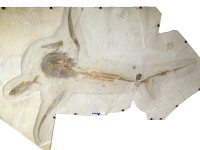
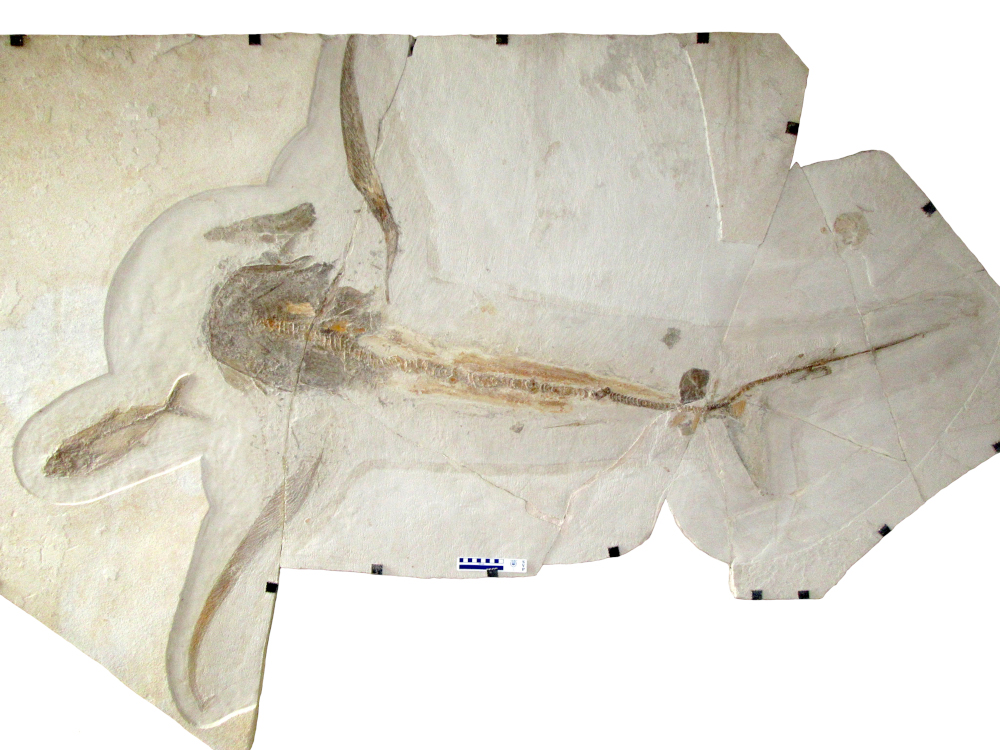
Aquilolamna milarcae Vullo, Frey, Ifrim, González, Stinnesbeck & Stinnesbeck, 2021, holotype, (INAH 2544 P.F.17), Vallecillo quarry area, Nuevo León State, Mexico © Wolfgang Stinnesbeck, Romain Vullo
Aquilolamna milarcae Vullo, Frey, Ifrim, González, Stinnesbeck & Stinnesbeck, 2021, holotype, (INAH 2544 P.F.17), Vallecillo quarry area, Nuevo León State, Mexico © Wolfgang Stinnesbeck, Romain Vullo
Distribution Stratigraphy
Vallecillo Member of the Agua Nueva Formation, middle–upper Pseudaspidoceras flexuosum Zone, lower Turonian, Upper Cretaceous [29456]
Vallecillo Member of the Agua Nueva Formation, middle–upper Pseudaspidoceras flexuosum Zone, lower Turonian, Upper Cretaceous [29456]
Description
Original diagnosis after Vullo et al. (2021) p. suppl. text p. 5 [29456]: Medium-sized neoselachian shark that differs from all other selachimorphs in having hypertrophied, scythe-shaped plesodic pectoral fins whose span exceeds the total length of the animal. High number (~70) of anteriorly directed pectoral radials. Head short and broad, with wide and near-terminal mouth. Caudal fin markedly heterocercal. Caudal fin skeleton showing a high hypochordal ray angle (i.e., ventrally directed hypochordal rays). Caudal tip slender with no (or strongly reduced?) terminal lobe. Squamation strongly reduced (or completely absent?).
Original diagnosis after Vullo et al. (2021) p. suppl. text p. 5 [29456]: Medium-sized neoselachian shark that differs from all other selachimorphs in having hypertrophied, scythe-shaped plesodic pectoral fins whose span exceeds the total length of the animal. High number (~70) of anteriorly directed pectoral radials. Head short and broad, with wide and near-terminal mouth. Caudal fin markedly heterocercal. Caudal fin skeleton showing a high hypochordal ray angle (i.e., ventrally directed hypochordal rays). Caudal tip slender with no (or strongly reduced?) terminal lobe. Squamation strongly reduced (or completely absent?).
References


Reassessment of the possible size, form, weight, cruising speed, and growth parameters of the extinct megatooth shark, Otodus megalodon (Lamniformes: Otodontidae), and new evolutionary insights into its gigantism, life history strategies, ecology, and extinction Palaeontologia Electronica, 28(1), Article a12
DOI: 10.26879/1502
Manta-like planktivorous sharks in Late Cretaceous oceans. Science, 371(6535), 1253–1256
DOI: 10.1126/science.abc1490
Ethical controversy swirls around shark fossil from Mexico. Science, 372(6540), 332–333
DOI: 10.1126/science.372.6540.332
Reassessment of the possible size, form, weight, cruising speed, and growth parameters of the extinct megatooth shark, Otodus megalodon (Lamniformes: Otodontidae), and new evolutionary insights into its gigantism, life history strategies, ecology, and extinction Palaeontologia Electronica, 28(1), Article a12
DOI: 10.26879/1502
Manta-like planktivorous sharks in Late Cretaceous oceans. Science, 371(6535), 1253–1256
DOI: 10.1126/science.abc1490
Ethical controversy swirls around shark fossil from Mexico. Science, 372(6540), 332–333
DOI: 10.1126/science.372.6540.332