Latest Research Articles
Extant Chondrichthyes:
Alfaro-Shigueto, J. & Guidino, C. & Mangel, J.C. & Velez-Zuazo, X. (2026): The extent of substitution in seafood commerce in Peru. Food Control, 179, Article 111579 https://dx.doi.org/10.1016/j.foodcont.2025.111579
Alvarenga, M.M. & Bunholi, I.V. & Adachi, A.M.C.L. & Cruz, M.M. & Feitosa, L.M. & de Jesus, E.V. & Lopes, M.E.L. & Povill, C. & Souza, D. & Torres, Y. & Sole-Cava, A.M. & Domingues, R.R. & Charvet, P. & da Cruz, V.P. (2025): Rapid DNA/eDNA-Based ID Tools for Improved Chondrichthyan Monitoring and Management. Molecular Ecology Resources, in press https://dx.doi.org/10.1111/1755-0998.70044
Amadori, M. & Staggl, M. & Mollen, F.H. & Villalobos-Segura, E. & Kriwet, J. (2025): Lines of distinction: morphometric tools for exploring past and present taxonomic diversities of galeomorph sharks [Abstract]. 85th Annual Meeting of the Society of Vertebrate PaleontologyAt: Birmingham, UK
Amini, S.R. & Feutry, P. & Phillips, N.M. & Kyne, P.M. (2025): A review of the utility and application of relatedness and kinship in elasmobranchs. Reviews In Fish Biology and Fisheries, in press https://dx.doi.org/10.1007/s11160-025-09983-2
Andrade, S.M.V. & Bayse, S.M. & Snook, M. & Kelly, D. & Winger, P.D. & Delouche, H. & Araya-Schmidt, T. & Santos, M.R. (2025): Effectiveness of northern shrimp trawls designed to reduce megafauna bycatch. ICES Journal of Marine Science, 82(8), Article fsaf150 https://dx.doi.org/10.1093/icesjms/fsaf150
Appert, C. & Wolfe, B. & Tracey, S. & Masere, C. & Wotherspoon, S.J. & Cleeland, J. (2025): Behavioural indicators of post-release survival in a deep-sea skate. Proceedings of The Royal Society B-Biological Sciences, 292(2052), Article 20251345 https://dx.doi.org/10.1098/rspb.2025.1345
Araujo, M.L. & Fontenelle, J.P. & Melo, S. (2025): Potamotrygon marquesi The IUCN Red List of Threatened Species 2025: e.T199350704A199350707 https://dx.doi.org/10.2305/IUCN.UK.2025-2.RLTS.T199350704A199350707.en
Araujo, M.L. & Torres, Y.T.P. & Charvet, P. & Sayer, C. (2025): Potamotrygon albimaculata The IUCN Red List of Threatened Species 2025: e.T188062971A188067169 https://dx.doi.org/10.2305/IUCN.UK.2025-2.RLTS.T188062971A188067169.en
Arcioni, M. & D’Ambra, I. & Vizzini, S. & Scannella, D. & Calabrò, M. & Falsone, F. & Geraci, M.L. & Oliverio, M. & Vitale, S. & Garofalo, G. & Bono, G. & Colloca, F. (2025): Trophic ecology of the deep-sea skate Dipturus oxyrinchus (Linnaeus, 1758) in the bathyal food web of the central Mediterranean Sea. Deep-Sea Research Part I-Oceanographic Research Papers, 225, Article 104602 https://dx.doi.org/10.1016/j.dsr.2025.104602
Armstrong, A.O. (2025): Neotrygon ningalooensis The IUCN Red List of Threatened Species 2025: e.T195463A124545936 https://dx.doi.org/10.2305/IUCN.UK.2025-2.RLTS.T195463A124545936.en
Armstrong, A.O. & Grant, M.I. & Lear, K.O. (2025): Neotrygon leylandi The IUCN Red List of Threatened Species 2025: e.T60156A124445169 https://dx.doi.org/10.2305/IUCN.UK.2025-2.RLTS.T60156A124445169.en
Armstrong, A.O. & Huveneers, C. & Kyne, P.M. (2025): Notoraja hirticauda The IUCN Red List of Threatened Species 2025: e.T161647A124521106 https://dx.doi.org/10.2305/IUCN.UK.2025-2.RLTS.T161647A124521106.en
Armstrong, A.O. & Kyne, P.M. (2025): Notoraja ochroderma The IUCN Red List of Threatened Species 2025: e.T161559A124506496 https://dx.doi.org/10.2305/IUCN.UK.2025-2.RLTS.T161559A124506496.en
Atkins, S. & Mann-Lang, J. & Cliff, G. & Olbers, J.M. & Kock, A.A. & Lucrezi, S. & Griffiths, M.K.P. & Jordaan, T. & Ploen, S. & Matthee, C.A. & Pillay, N. & Cantor, M. (2025): Navigating transdisciplinary waters to protect both sharks and bathers in KwaZulu-Natal, South Africa: diverse stakeholders propose potential actions. Ecology and Society, 30(3), Article 18 https://dx.doi.org/10.5751/ES-16288-300318
Atkinson, C.J.L. & Collin, S.P. (2025): Surface morphology and distribution of oropharyngeal taste papillae in sharks and rays (Elasmobranchii, Chondrichthyes): Implications for gustatory sensitivity. Journal of Anatomy, in press https://dx.doi.org/10.1111/joa.14278
Auditore, L. & Pierce, S. & Prebble, C. & Flam, A. & Marshall, A. & Venables, S. & Watts, A. & Reeve-Arnold, K. & Domenico, G. & Keeping, J. & Mendez-Jimenez, A. & Riensema, A. & Rosero, M. & Cumbana, L. & Tilley, A. & Westling, A. & Williams, C. & Rohner, C. (2025): A 15-Year Time Series Shows Major Declines in Whale Sharks in Southern Mozambique. Aquatic Conservation-Marine and Freshwater Ecosystems, 35(10), Article e70224 https://dx.doi.org/10.1002/aqc.70224
Awruch, C.A. & Kyne, P.M. & Charles, R. (2025): Okamejei arafurensis The IUCN Red List of Threatened Species 2025: e.T195469A124546589 https://dx.doi.org/10.2305/IUCN.UK.2025-2.RLTS.T195469A124546589.en
Azevedo , I. & Reiner , F. & Robalo, J.I. & Avellaneda-Rodriguez, K. & Sousa, R. & Freitas, M. & Ideia-Freitas, P. & Pereira , A.M. (2025): Low mitochondrial genetic diversity and distribution of the goblin shark (Mitsukurina owstoni Jordan, 1898). Revista Ciencias Marinas y Costeras, 17(2), 87–105 https://dx.doi.org/10.15359/revmar.17-2-5
Azevedo, I. & Reiner, F. & Robalo, J.I. & Avellaneda-Rodriguez, K. & Sousa, R. & Freitas, M. & Ideia-Freitas, P. & & Pereira, A.M. (2025): Low mitochondrial genetic diversity and distribution of the goblin shark (Mitsukurina owstoni Jordan, 1898) [Baja diversidad genética mitocondrial y distribución del tiburón duende (Mitsukurina owstoni Jordan, 1898)] Revista Ciencias Marinas Y Costeras, 17(2), 87–105 https://dx.doi.org/10.15359/revmar.17-2-5
Bañeras, T. & Jimenez-Alvarado, D. & Meyers, E.K.M. & Toledo-Padilla, H. & Hardisson, A. & Gonzalez-Weller, D. & Barker, J. & Mead, L.R. & Espino-Ruano, A. & Castro-Alonso, A. & José-Caballero, M. & Gutiérrez, A. (2025): Characterization of metal contaminants in the Critically Endangered angelshark (Squatina squatina): A first ecotoxicological insight. Marine Pollution Bulletin, 222, Article 118602 https://dx.doi.org/10.1016/j.marpolbul.2025.118602
Bargione, G. & Pardini, A. & Donato, F. & Veli, D.L. & Sabatini, L. & Sepe, E. & Scarcella, G. & Lucchetti, A. (2025): Managing the starry ray (Raja asterias) in the mid-western Adriatic Sea: why sex matters in fisheries conservation. Frontiers In Marine Science, 12, Article 1679293 https://dx.doi.org/10.3389/fmars.2025.1679293
Baum, M. & Haussecker, T. & Walenciak, O. & Köhler, S. & Bridges, C.R. & Fraune, S. (2025): Simulated ocean acidification affects shark tooth morphology. Frontiers In Marine Science, 12, Article 1597592 https://dx.doi.org/10.3389/fmars.2025.1597592
Bazzi, M. & Lloyd, W.L. & Ebersole, J.A. & Sternes, P.C. & Al Aswad, J.A. & Payne, J.L. (2025): Extinction threatens to cause morphological and ecological homogenization in sharks. Science Advances, 11, Article eaea0278 https://dx.doi.org/10.1126/sciadv.aea0278
Beaufort, O. (2025): Sharks, Rays, and Chimeras of the French West Indies: Diversity, Status, and Conservation Needs Assessment. Caribbean Journal of Science, 55(2), 271–302 https://dx.doi.org/10.18475/cjos.v55i2.a1
Beaufort, O. & Prieto González, R. (2025): INA Scuba: Mobilization of French West Indies scuba diving clubs to rapidly improve knowledge on threatened marine species. Case of the white-spotted eagle ray (Aetobatus narinari). Gulf and Caribbean Research, 36(1), GCFI 19–GCFI 35 https://dx.doi.org/10.18785/gcr.3601.09
Besnard, L. & Le Croizier, G. & Sonke, J.E. & Galván-Magaña, F. & Trueman, C. & Martínez-Rincón, R.O. & Harrod, C. & Kraffe, E. & Point, D. & Soto-López, K. & Schaal, G. (2025): Using Carbon, Nitrogen, Sulfur, and Mercury Isotopes to Trace Elasmobranch Foraging Habitats in Contrasting Biogeochemical Environments. Environmental Science & Technology, 59(32), 16972–16984 https://dx.doi.org/10.1021/acs.est.5c01680
Bignami, G. & Pirollo, T. & Tedesco, P. & Caffara, M. & Fioravanti, M.L. & Campesi, E. & Da Rugna, C. & Gridelli, S. & Quaglio, F. & Gustinelli, A. (2025): Fatal Hemorrhagic Septicemia in Common Guitarfish (Rhinobatos rhinobatos) Caused by Photobacterium damselae Subsp. damselae in a Controlled Environment. Journal of Fish Diseases, in press https://dx.doi.org/10.1111/jfd.70066
Bilgin, Ö. (2025): Comparison of Nutritional Quality of Amino Acid in Elasmobranchii Species: Thornback Ray, Raja clavata (Rajidae) and Common Stingray, Dasyatis pastinaca (Dasyatidae) with Implications to Human Health. Thalassas, 41(3), Article 177 https://dx.doi.org/10.1007/s41208-025-00935-y
Bizzarro, J.J. & Rigby, C.L. & Ebert, D.A. & Armstrong, A.O. (2025): Caliraja stellulata The IUCN Red List of Threatened Species 2025: e.T161629A124517861 https://dx.doi.org/10.2305/IUCN.UK.2025-2.RLTS.T161629A124517861.en
Boube, T. & Huveneers, C. & Papastamatiou, Y.P. & Wong-Sang, S. & Charleux, F. & Gaertner, J.C. (2025): Life stage-specific habitat use and trophic ecology of the critically endangered great hammerhead (Sphyrna mokarran). Reviews In Fish Biology and Fisheries, 35, 2235–2259 https://dx.doi.org/10.1007/s11160-025-10001-8
Bouzidi, I. & Enajjar, S. & Bradai, M.N. & Saidi, B. (2025): Diversity, occurrence and status of sharks in the Gulf of Hammamet (Central Mediterranean Sea). Marine Biodiversity, 55(6), Article 87 https://dx.doi.org/10.1007/s12526-025-01584-3
Braccini, M. & Hesp, A. & Cope, J. & Rynvis, L. & Watt, M. & Syers, C. & Jackson, G. & Newman, S. (2025): Multidecadal Management Ensures High Sustainability and Low Risk in a Global Shark Biodiversity Hotspot. Fish and Fisheries, in press https://dx.doi.org/10.1111/faf.70030
Bracken, F.S.A. & Sherman, Z. & Johnston, E.M. & Pfeiffer, N.J. & Massett, N. & O’Sullivan, K.M. & Wasik, S. & Berrow, S.D. & Kelly-Quinn, M. & Carlsson, J. (2025): Basking sharks (Cetorhinus maximus) in the Northeast Atlantic show high occurrence of parasitism by sea lamprey (Petromyzon marinus). Hydrobiologia, in press https://dx.doi.org/10.1007/s10750-025-05928-9
Bustamante, C. & Vargas-Caro, C. & Indurain, M.J. & Silva, G. (2025): Integrating Egg Case Morphology and DNA Barcoding to Discriminate South American Catsharks, Schroederichthys bivius and S. chilensis (Carcharhiniformes: Atelomycteridae). Diversity, 17(9), Article 651 https://dx.doi.org/10.3390/d17090651
Cáceres, C. & English-Clarke, T.L. & Graham, J. (2025): Five Years of Minorities in Shark Sciences: Lessons Learned in Education and Outreach, Professional Development and Training, and Inclusive Research. Integrative and Comparative Biology, in press https://dx.doi.org/10.1093/icb/icaf144
Campos-León, S. & Hernández-Muñoz, S. & Huerta-Beltrán, B.L. & Zavalaga, F. & Cevallos-Garcias, A. & Ehemann, N. (2025): Peruvian Chondrichthyes biodiversity, marketing and conservation: a synthesis of current knowledge. Journal of Fish Biology, in press https://dx.doi.org/10.1111/jfb.70227
Campos-León, S. & Zavalaga, F. & Huerta-Beltrán, B.L. & Lucero-Perez, S. & Ehemann, N. (2025): First documentation of gravid Alopias vulpinus (Bonnaterre, 1788) in the southeastern Pacific: Evidence for a potential maternal corridor. Journal of Fish Biology, in press https://dx.doi.org/10.1111/jfb.70243
Campos-Sosa, A. & Crespo-Picazo, J.L. & Muñoz-Baquero, M. & Garcia-Salinas, P. & Penadés-Suay, J. & García-Párraga, D. & Ortega, J. (2025): Pathology of stranded blue sharks (Prionace glauca) impaled by swordfish (Xiphias gladius). Scientific Reports, 15(1), Article 29546 https://dx.doi.org/10.1038/s41598-025-13617-9
Carbonara, P. & Bellodi, A. & Bottaro, M. & Deplano, G. & Mulas, A. & Neglia, C. & Niedermüller, S. & Prato, G. & Toomey, L. & Follesa, M.C. (2025): Insights Into the Ecomorphology of the Blue Shark (Prionace glauca) in the Adriatic Sea (Central Mediterranean Sea). Ecology and Evolution, 15, Article e72478 https://dx.doi.org/10.1002/ece3.72478
Carbonara, P. & Campioni, N. & Zupa, W. & Bellodi, A. & Bottaro, M. & Neglia, C. & Follesa, M.C. & Toomey, L. (2026): From hormones to habitat: A new framework for assessing maturity in the Central-Eastern Mediterranean blue shark (Prionace glauca) population. Marine Environmental Research, 214, Article 107745 https://dx.doi.org/10.1016/j.marenvres.2025.107745
Cardeñosa, D. (2025): First record of chafing behavior by silky sharks (Carcharhinus falciformis) on oceanic manta rays (Mobula birostris) at Malpelo Island, Colombia. Marine Biodiversity, 55(5), Article 85 https://dx.doi.org/10.1007/s12526-025-01573-6
Carrasco-Puig, P. & Colmenero, A.I. & Degollada, E. & Tort, B. & Jara, D. & Marco, N. & Ruiz-Olmo, J. & Carbonell, F. & Barría, C. (2025): The elusive spinetail devil ray (Mobula mobular): a multimethod approach to track its presence in the Spanish Mediterranean Sea. Journal of Fish Biology, in press https://dx.doi.org/10.1111/jfb.70241
Castelo-Corona, A.P. & Maldonado-Gasca, A. & Pérez-Jiménez, J.C. & Tovar-Ávila, J. (2025): Habitat use of the Pacific eagle ray Aetobatus laticeps (Myliobatiformes: Aetobatidae) in a marine protected area of touristic importance, Banderas Bay, Mexico Revista de Biología Tropical, 73, Article e2025200 https://dx.doi.org/10.15517/29wq2j10
Castrejon, M. (2025): Revealing the unseen: Shark finning in the Galapagos Marine Reserve through illegal fishers’ eyes and a situational crime prevention approach. Biological Conservation, 311, Article 111452 https://dx.doi.org/10.1016/j.biocon.2025.111452
Chacon, Y.N.S. & Whitcraft, C.R. & Anderson, J.M. & Spurgeon, E. & Rex, P. & Jahn, E.E. & Merson, Z.S. & Lowe, C.G. (2025): Differences in juvenile white sharks’ (Carcharodon carcharias) resource use in southern California waters. Wildlife Research, 52(8), Article WR24183 https://dx.doi.org/10.1071/WR24183
Charvet, P. & Araujo, M.L. & Torres, Y.T.P. (2025): Potamotrygon scobina The IUCN Red List of Threatened Species 2025: e.T44594A2997445 https://dx.doi.org/10.2305/IUCN.UK.2025-2.RLTS.T44594A2997445.en
Charvet, P. & Góes de Araújo, M.L. & Torres, Y.T.P. & Fernando, E. & Sayer, C. (2025): Paratrygon parvaspina The IUCN Red List of Threatened Species 2025: e.T214418514A214418525 https://dx.doi.org/10.2305/IUCN.UK.2025-2.RLTS.T214418514A214418525.en
Charvet, P. & Sayer, C. & Torres, Y.T.P. (2025): Heliotrygon gomesi The IUCN Red List of Threatened Species 2025: e.T58428937A58431598 https://dx.doi.org/10.2305/IUCN.UK.2025-2.RLTS.T58428937A58431598.en
Chen, H.H. & Wang, S.P. & Tu, Y.A. & Tsai, W.P. (2025): Machine learning approach for estimating length-weight relationships in key shark species to support fisheries management. Ecological Informatics, 91, Article 103425 https://dx.doi.org/10.1016/j.ecoinf.2025.103425
Çiftçi, N. & Ayas, D. (2025): Metal(loid) accumulation and ecotoxicological assessment in cartilaginous fishes from the Northeastern Mediterranean. Regional Studies In Marine Science, 89, Article 104373 https://dx.doi.org/10.1016/j.rsma.2025.104373
Clarke, T.M. & Butcher, P.A. & Green, M. & Whitelaw, J. & Meyer, L. & Huveneers, C. (2025): Effectiveness of bite-resistant materials to reduce injuries from white shark (Carcharodon carcharias) and tiger shark (Galeocerdo cuvier) bites. Wildlife Research, 52(10), Article WR25019 https://dx.doi.org/10.1071/WR25019
Clua, E.E.G. & Parton, K.J. (2025): When Competition Breaks the Rules: Feeding Frenzy as a Trigger for Unexpected Fatal Shark Predation Bites on a Human Sea-User by Non Traumatogenic Carcharinids in the Oriental Mediterranean. Ethology, in press https://dx.doi.org/10.1111/eth.70013
Constance, J.M. & Udyawer, V. & Pillans, R.D. & Johnson, G. & Saunders, T. & Usher, M. & Garcia, E.A. & Kyne, P.M. (2025): Acoustic telemetry provides mortality estimates for threatened river sharks in the Northern Territory, Australia. Animal Biotelemetry, 13(1), Article 30 https://dx.doi.org/10.1186/s40317-025-00425-1
Contreras, I. & Zagal, C.J. & Ruiz, J, (2025): Tiburones, rayas y quimeras de Chile / Sharks, rays and chimaeras of Chile. Valdivia, Chile, Fundación Oceanósfera. 200 pp.
Cresswell, B.J. & Galbraith, G.F. & Barnett, A. & Harrison, H.B. & Jones, G.P. & Mcclure, E.C. & Quimpo, T& Hoey, A.S. (2025): Limited Evidence for Depth Specialism in Isolated Seamount Reef Predators. Ecology and Evolution, 15(9), Article e72044 https://dx.doi.org/10.1002/ece3.72044
Crochelet, E. & Desbonnes, O. & Inçaby, L. & Nazurally, N. & Stevens, G. & van Beuningen, D. & Gadenne, J. & Morand, G. & Bertrand, G. & Nikolic, N. (2025): Biodiversity and conservation of elasmobranchs in the Mascarene Islands: Policy implementation and protection strategies. Ocean & Coastal Management, 270, Article 107921 https://dx.doi.org/10.1016/j.ocecoaman.2025.107921
Cronin, M.R. & Murua, J. & Croll, D.A. & Hutchinson, M. & Lezama-Ochoa, N. & Lopez, J. & Murua, H. & Palacios, M.D. & Restrepo, V. & Stewart, J.D. & Swimmer, Y. & Zilliacus, K.M. & Moreno, G. (2025): Evidence for a fisher-designed solution to manta and devil ray bycatch in tuna fisheries. Conservation Biology, in press https://dx.doi.org/10.1111/cobi.70150
da Silva, C.A. & Mayer, G.B. & Bertoncini, A.A. & de Lima, R. & de Freitas, R.H.A. (2025): A three-year survey of hatched elasmobranch egg capsules on Santa Catarina Island, Southern Brazil. Continental Shelf Research, 293, Article 105528 https://dx.doi.org/10.1016/j.csr.2025.105528
Dahms, C. & Vigliola, L. & Cheung, L.H.T. & Hui, J.H.L. & Momigliano, P. (2025): Chromosome-Level Assembly and Annotation of the Grey Reef Shark (Carcharhinus amblyrhynchos) Genome. Genome Biology and Evolution, 17(10), Article evaf176 https://dx.doi.org/10.1093/gbe/evaf176
Dannemiller, N.G. & Knutson, K.A. & Arnold, J.E. & Pazmino, D.A. & Hearn, A.R. & Lewbart, G.A. & Petritz, O.A. (2025): PRELIMINARY HEMATOLOGY AND BIOCHEMISTRY REFERENCE INTERVALS IN JUVENILE BLACKTIP SHARKS (CARCHARHINUS LIMBATUS) IN THE GALÁPAGOS MARINE RESERVE. Journal of Zoo and Wildlife Medicine, 56(3), 599–607 https://dx.doi.org/10.1638/2024-0027
de Belen Chacón-Paz, M. & Sánchez-Jiménez, J. & Areano, E. & Pérez-Jiménez, J.C. (2026): New record of Rostroraja velezi and updated observations of Rostroraja equatorialis in the Guatemalan Pacific. Regional Studies in Marine Science, 93, Article 104664 https://dx.doi.org/10.1016/j.rsma.2025.104664
de Carvalho-Souza, G.F. & Palazzo, J.T. (2025): Brazilian policy weakens shark conservation. Science, 389(6762), Article https://dx.doi.org/10.1126/science.adz3632
Delaval, A. & Clegg, T. & Lynghammar, A. & Bruvold, I.M. & Tranang, C.A. & Williams, T. (2025): The distribution of skates (Order Rajiformes) along the Norwegian continental shelf and slope. Ices Journal of Marine Science, 82(9), Article fsaf172 https://dx.doi.org/10.1093/icesjms/fsaf172
Devcic, L. & Vlahek, I. & Palic, M. & Benko, V. & Faraguna, S. & Lovric, M. & Valic, D. & Kuzir, S. (2025): Histochemical Study of Enzyme Activity in the Digestive Tract of the Small-Spotted Catshark (Scyliorhinus canicula) and the Smooth-Hound (Mustelus mustelus). Fishes, 10(8), Article 386 https://dx.doi.org/10.3390/fishes10080386
DeVries, C. & Gartland, J. & Latour, R.J. (2025): Patterns in spiny dogfish consumption by sex and maturity stage relate to prey availability and environmental forcing in the Northwest Atlantic. Frontiers In Marine Science, 12, Article 1621343 https://dx.doi.org/10.3389/fmars.2025.1621343
Ding, P.P. & Katayama, S. & Murakami, H. & Ryan, T.A. (2025): Ontogenetic and Sex-Specific Isotopic Niches of Blue Sharks (Prionace glauca) in the Northwestern Pacific. Fishes, 10(8), Article 402 https://dx.doi.org/10.3390/fishes10080402
Drummond, J.M. & Macpherson, J. & Anderson, W.G. & Weinrauch, A.M. (2025): The elasmobranch digestive system - current status and future directions. Journal of Experimental Biology, 228(14), Article jeb249776 https://dx.doi.org/10.1242/jeb.249776
Drymon, J.M. & Jargowsky, A.E. & Switzer, T.S. & Hightower, C.L. & Powers, S.P. (2025): Fishery-independent camera surveys provide novel observations of white sharks (Carcharodon carcharias) off coastal Alabama. Frontiers In Marine Science, 12, Article 1628084 https://dx.doi.org/10.3389/fmars.2025.1628084
Ebert, D.A. & Concha, F. (2025): Bathyraja aguja (amended version of 2020 assessment) The IUCN Red List of Threatened Species 2025: e.T61399A277727182 https://dx.doi.org/10.2305/IUCN.UK.2025-2.RLTS.T61399A277727182.en
Emmons, S.M. & Rummer, J.L. & Kilborn, J.P. & Pierce, M.A. & Timpe, A.W. & Simpfendorfer, C.A. & Seibel, B.A. (2025): Euryhaline Atlantic stingray (Hypanus sabinus) exhibit elevated oxygen supply capacity in hyposaline water: implications for estuarine species resilience and conservation. Conservation Physiology, 13(1), Article coaf071 https://dx.doi.org/10.1093/conphys/coaf071
Epstein, H.A.N.X. & Hagood, M.E. & Meredith, T.L. & Porter, M.E. (2025): Zooming in on Bonnetheads: Quantifying Impacts of Maturity on Denticle Morphology. Integrative and Comparative Biology, in press https://dx.doi.org/10.1093/icb/icaf115
Estupiñán-Montaño, C. & Villalobos-Ramirez, D.J. & Galván-Magaña, F. & Elorriaga-Verplancken, F.R. & Zentina-Rejón, M.J. & Sánchez-González, A. & Polo-Silva, C.J. & Delgado-Huertas, A. (2025): Ontogenetic feeding ecology of the silky shark (Carcharhinus falciformis) in the Colombian eastern tropical Pacific. Environmental Biology of Fishes, in press https://dx.doi.org/10.1007/s10641-025-01747-y
Fakioglu, Y.E. & Gökçe, G. & Herrmann, B. & Özbilgin, H. (2025): Performance of an excluder grid to mitigate bycatch of sharks in deep-water red shrimp trawl fishery. Journal For Nature Conservation, 87, Article 127009 https://dx.doi.org/10.1016/j.jnc.2025.127009
Faure, J. & Péron, C. & Grüss, A. (2025): Impacts of management measures to address skate bycatch in the Southern Ocean: Evaluating Whiteleg skate (Amblyraja taaf) abundance and fishing mortality trends in Crozet Islands. Fisheries Research, 291, Article 107559 https://dx.doi.org/10.1016/j.fishres.2025.107559
Faure, N. & Vilcot, M. & Pichot, F. & Riutort, J. & Barroil, A. & Holon, F. & Tomasi, N. & Mouillot, D. & Deter, J. & Manel, S. (2025): A Fragile Stronghold: Genomics Reveal Angelshark Population Vulnerability in Corsica, a Key Mediterranean Refuge. Ecology and Evolution, 15(10), Article e72275 https://dx.doi.org/10.1002/ece3.72275
Ferretti, F. & Jenrette, J. & Moro, S. & Butner, C. & Fox, E. & Haddock, S.H.D. & Jorgensen, S.J. & Hastie, T. & Micheli, F. (2025): From Data Deficient to Big Data in Shark Conservation. Fish and Fisheries, in press https://dx.doi.org/10.1111/faf.70006
Finucci, B. (2025): Squalus hima The IUCN Red List of Threatened Species 2025: e.T266886335A266886724 https://dx.doi.org/10.2305/IUCN.UK.2025-2.RLTS.T266886335A266886724.en
Finucci, B. & Armstrong, A.O. (2025): Orectolobus reticulatus The IUCN Red List of Threatened Species 2025: e.T195439A124542708 https://dx.doi.org/10.2305/IUCN.UK.2025-2.RLTS.T195439A124542708.en
Finucci, B. & Armstrong, A.O. (2025): Dentiraja flindersi The IUCN Red List of Threatened Species 2025: e.T195443A124543218 https://dx.doi.org/10.2305/IUCN.UK.2025-2.RLTS.T195443A124543218.en
Finucci, B. & Armstrong, A.O. (2025): Apristurus platyrhynchus The IUCN Red List of Threatened Species 2025: e.T44223A124431568 https://dx.doi.org/10.2305/IUCN.UK.2025-2.RLTS.T44223A124431568.en
Finucci, B. & Armstrong, A.O. (2025): Apristurus sinensis The IUCN Red List of Threatened Species 2025: e.T44225A124431849 https://dx.doi.org/10.2305/IUCN.UK.2025-2.RLTS.T44225A124431849.en
Finucci, B. & Charles, R. (2025): Etmopterus brachyurus The IUCN Red List of Threatened Species 2025: e.T161649A124521547 https://dx.doi.org/10.2305/IUCN.UK.2025-2.RLTS.T161649A124521547.en
Finucci, B. & Ellis, J.R. & McCully-Phillips, S.R. & Pacoureau, N. & Rohner, C.A. & Serena, F. (2025): Leucoraja naevus The IUCN Red List of Threatened Species 2025: e.T161626A124517373 https://dx.doi.org/10.2305/IUCN.UK.2025-2.RLTS.T161626A124517373.en
Finucci, B. & Ellis, J.R. & McCully-Phillips, S.R. & Serena, F. & Charles, R. (2025): Leucoraja circularis The IUCN Red List of Threatened Species 2025: e.T161464A124490090 https://dx.doi.org/10.2305/IUCN.UK.2025-2.RLTS.T161464A124490090.en
Finucci, B. & García, E. & Kulka, D.W. & Orlov, A.M. (2025): Amblyraja hyperborea The IUCN Red List of Threatened Species 2025: e.T205175804A124460245 https://dx.doi.org/10.2305/IUCN.UK.2025-2.RLTS.T205175804A124460245.en
Finucci, B. & García, E. & Pacoureau, N. & Serena, F. (2025): Leucoraja melitensis The IUCN Red List of Threatened Species 2025: e.T61405A124456941 https://dx.doi.org/10.2305/IUCN.UK.2025-2.RLTS.T61405A124456941.en
Finucci, B. & Green, M.E. & Rigby, C.L. & Simpfendorfer, C.A. (2025): Gulper shark identification guide. University of Tasmania, Hobart, Australia. 37 pp
Finucci, B. & Kulka, D.W. & Armstrong, A.O. (2025): Harriotta raleighana The IUCN Red List of Threatened Species 2025: e.T278016856A268401245 https://dx.doi.org/10.2305/IUCN.UK.2025-2.RLTS.T278016856A268401245.en
Finucci, B. & Kyne, P.M. & Rohner, C.A. (2025): Scymnodon macracanthus The IUCN Red List of Threatened Species 2025: e.T267134970A267136939 https://dx.doi.org/10.2305/IUCN.UK.2025-2.RLTS.T267134970A267136939.en
Finucci, B. & Matta, M.E. & Tribuzio, C.A. & Charles, R. (2025): Bathyraja mariposa The IUCN Red List of Threatened Species 2025: e.T161319A124464889 https://dx.doi.org/10.2305/IUCN.UK.2025-2.RLTS.T161319A124464889.en
Finucci, B. & Matta, M.E. & Tribuzio, C.A. & Charles, R. (2025): Bathyraja panthera The IUCN Red List of Threatened Species 2025: e.T80671020A266349445 https://dx.doi.org/10.2305/IUCN.UK.2025-2.RLTS.T80671020A266349445.en
Finucci, B. & Rigby, C.L. & Ellis, J.R. & McCully-Phillips, S.R. & Serena, F. & Charles, R. (2025): Leucoraja fullonica The IUCN Red List of Threatened Species 2025: e.T161461A124489576 https://dx.doi.org/10.2305/IUCN.UK.2025-2.RLTS.T161461A124489576.en
Finucci, B. & Rohner, C.A. (2025): Bathyraja spinosissima The IUCN Red List of Threatened Species 2025: e.T161486A124494104 https://dx.doi.org/10.2305/IUCN.UK.2025-2.RLTS.T161486A124494104.en
Finucci, B. & Rohner, C.A. (2025): Leucoraja longirostris The IUCN Red List of Threatened Species 2025: e.T261711018A261711040 https://dx.doi.org/10.2305/IUCN.UK.2025-2.RLTS.T261711018A261711040.en
Finucci, B. & Rohner, C.A. (2025): Harriotta avia The IUCN Red List of Threatened Species 2025: e.T266886596A266886710 https://dx.doi.org/10.2305/IUCN.UK.2025-2.RLTS.T266886596A266886710.en
Finucci, B. & Rohner, C.A. (2025): Cephaloscyllium ventriosum The IUCN Red List of Threatened Species 2025: e.T60227A124453628 https://dx.doi.org/10.2305/IUCN.UK.2025-2.RLTS.T60227A124453628.en
Fish, F.E. & Gabler-Smith, M.K. & Mulvany, S. & Moored, K.W. (2025): Hydrodynamically Derived Negative Lift Generation of the Cephalic Lobes of Foraging Benthopelagic Myliobatids to Maintain Ground Contact. Journal of Morphology, 286(9), Article e70085 https://dx.doi.org/10.1002/jmor.70085
Flem, L.M. & Charles, R. (2025): Narcinops nelsoni The IUCN Red List of Threatened Species 2025: e.T195460A124545632 https://dx.doi.org/10.2305/IUCN.UK.2025-2.RLTS.T195460A124545632.en
Flem, L.M. & Charles, R. (2025): Narcinops ornata The IUCN Red List of Threatened Species 2025: e.T195462A124545778 https://dx.doi.org/10.2305/IUCN.UK.2025-2.RLTS.T195462A124545778.en
Flem, L.M. & Huveneers, C. & Rohner, C.A. (2025): Insentiraja subtilispinosa The IUCN Red List of Threatened Species 2025: e.T161553A124505484 https://dx.doi.org/10.2305/IUCN.UK.2025-2.RLTS.T161553A124505484.en
Flem, L.M. & Kyne, P.M. & Rohner, C.A. (2025): Narcinops tasmaniensis The IUCN Red List of Threatened Species 2025: e.T161628A124517636 https://dx.doi.org/10.2305/IUCN.UK.2025-2.RLTS.T161628A124517636.en
Flem, L.M. & Lyons, K. & Lowe, C.G, Ebert, D.A. & Saldaña Ruiz, L. (2025): Urobatis halleri The IUCN Red List of Threatened Species 2025: e.T60108A124438758 https://dx.doi.org/10.2305/IUCN.UK.2025-2.RLTS.T60108A124438758.en
Flem, L.M. & Rohner, C.A. (2025): Narcinops westraliensis The IUCN Red List of Threatened Species 2025: e.T161346A124469680 https://dx.doi.org/10.2305/IUCN.UK.2025-2.RLTS.T161346A124469680.en
Flem, L.M. & Rohner, C.A. (2025): Narcinops lasti The IUCN Red List of Threatened Species 2025: e.T161700A124530355 https://dx.doi.org/10.2305/IUCN.UK.2025-2.RLTS.T161700A124530355.en
Flem, L.M. & Rohner, C.A. (2025): Hemitrygon parvonigra The IUCN Red List of Threatened Species 2025: e.T195442A124543000 https://dx.doi.org/10.2305/IUCN.UK.2025-2.RLTS.T195442A124543000.en
Fontenelle, J.P. & Sayer, C. & Fernando, E. (2025): Potamotrygon adamastor The IUCN Red List of Threatened Species 2025: e.T188060303A271884545 https://dx.doi.org/10.2305/IUCN.UK.2025-2.RLTS.T188060303A271884545.en
Franqui-Rivera, G. & Rodriguez-Ferrer, G. & Schizas, N. (2025): CORRIGENDUM to Collaborative effort between fishers and scientists reveals first-time evidence of the smalltooth sandtiger shark (Odontaspis ferox) in Puerto Rico (Vol 105, e58, 2025). Journal of The Marine Biological Association of The United Kingdom, 105, Article e99 https://dx.doi.org/10.1017/S0025315425100271
Furundarena, A. & Hernández, M. & Brito, A. & Mucientes, G. (2025): First Record of the Goblin Shark (Mitsukurina owstoni) in the Canary Islands. Thalassas, 41, Article 252 https://dx.doi.org/10.1007/s41208-025-01016-w
Gajic, A.A. (2025): Documenting the first neonate and juvenile rare deep-sea kitefin shark (Dalatias licha) in the Adriatic Sea, with insight into fishery-induced trauma. Environmental Biology of Fishes, 108(10), 1589–1598 https://dx.doi.org/10.1007/s10641-025-01737-0
Gambardella, C. & Fernández-Corredor, E. & Moro, S. & Echwiki, K. & Jenrette, J.F. & Lemsi, C. & Schallert, R.J. & Shea, B.D. & Zammit, M.C. & Cerrano, C. & Colloca, F. & Romeo, T. & Navarro, J. & Ferretti, F. (2025): Trophic niche partitioning between the white shark (Carcharodon carcharias) and the shortfin mako (Isurus oxyrinchus) in the central Mediterranean Sea. Wildlife Research, 52(10), Article WR25028 https://dx.doi.org/10.1071/WR25028
Gauna, C. & Sternes, P.C. (2025): Drone observations reveal white shark (Carcharodon carcharias) dorsal fins are highly flexible and possible investigatory structures. Journal of Fish Biology, in press https://dx.doi.org/10.1111/jfb.70210
Gausmann, P. & Matich, P. & Laurrabaquio-Alvarado, N.S. (2025): Research goals of special concern for Carcharhinus leucas (Carcharhiniformes: Carcharhinidae) in Latin America – biological, distributional, and conservation priorities. Neotropical Ichthyology, 23(3), Article e250034 https://dx.doi.org/10.1590/1982-0224-2025-0034
Gayford, J.H. & Soares, K.D. & Berio, F. (2025): Sexual ornamentation and weapons of sexual conflict in cartilaginous fishes. Reviews In Fish Biology and Fisheries, in press https://dx.doi.org/10.1007/s11160-025-10000-9
Gazo, M. & Canals, M. & González, N. & Nuez, I. & Garcia-Garin, O. (2025): Drivers of microplastic accumulation in a densely canyoned continental margin: Insights from blackmouth catsharks (Galeus melastomus). Marine Environmental Research, 211, Article 107402 https://dx.doi.org/10.1016/j.marenvres.2025.107402
Giacomin, M. & Schulte, P.M. & Wood, C.M. (2025): Osmorespiratory compromise in an elasmobranch: oxygen consumption, ventilation and nitrogen metabolism in dogfish sharks (Squalus suckleyi) exposed to hypoxia in different salinities. Journal of Comparative Physiology B-Biochemical Systems and Environmental Physiology, in press https://dx.doi.org/10.1007/s00360-025-01629-w
Góes de Araújo, M.L. & Sayer, C. & Fernando, E. & Torres, Y.T.P. & Charvet, P. (2025): Potamotrygon schroederi The IUCN Red List of Threatened Species 2025: e.T161365A886900 https://dx.doi.org/10.2305/IUCN.UK.2025-2.RLTS.T161365A886900.en
Góes de Araújo, M.L. & Torres, Y.T.P. & Sayer, C. & Charvet, P. (2025): Paratrygon aiereba The IUCN Red List of Threatened Species 2025: e.T284113569A892453 https://dx.doi.org/10.2305/IUCN.UK.2025-2.RLTS.T284113569A892453.en
Gomi, S. & Sakai, T. & Masubuchi, T. & Iseki, T. & Ohshimo, S. (2025): Estimation of isoscapes, trophic positions, and trophic niches of demersal fishes and squids in the East China Sea inferred from stable isotope ratios. Regional Studies In Marine Science, 89, Article 104335 https://dx.doi.org/10.1016/j.rsma.2025.104335
Gooden, A. & Rigby, C.L. & Charles, R. (2025): Halaelurus sellus The IUCN Red List of Threatened Species 2025: e.T42713A124427141 https://dx.doi.org/10.2305/IUCN.UK.2025-2.RLTS.T42713A124427141.en
Gosselin, C. & Maillaud, C. & Jourdel, F. (2025): Shark bites in New Caledonia: A retrospective study of 22 hospitalized cases and surgical management. Injury-International Journal of The Care of The Injured, 56(11), Article 112775 https://dx.doi.org/10.1016/j.injury.2025.112775
Graf, L.G. & Dalby, O. & Whitmarsh, S. & Ierodiaconou, D. & Young, M.A. (2025): Assessing the current and projected distributions of temperate sharks and rays in southeastern Australia. Regional Studies In Marine Science, 90, Article 104418 https://dx.doi.org/10.1016/j.rsma.2025.104418
Grant, M.I. & Braccini, J.M. & Huveneers, C. & Charles, R. (2025): Orectolobus parvimaculatus The IUCN Red List of Threatened Species 2025: e.T161651A124521951 https://dx.doi.org/10.2305/IUCN.UK.2025-2.RLTS.T161651A124521951.en
Grant, M.I. & Braccini, J.M. & Huveneers, C. & Charles, R. (2025): Orectolobus hutchinsi The IUCN Red List of Threatened Species 2025: e.T42717A124427292 https://dx.doi.org/10.2305/IUCN.UK.2025-2.RLTS.T42717A124427292.en
Grant, M.I. & Braccini, J.M. & Huveneers, C. & Charles, R. & Armstrong, A.O. (2025): Orectolobus floridus The IUCN Red List of Threatened Species 2025: e.T161664A124524288 https://dx.doi.org/10.2305/IUCN.UK.2025-2.RLTS.T161664A124524288.en
Grant, M.I. & Rigby, C.L. & Fernando, E. (2025): Zearaja maugeana The IUCN Red List of Threatened Species 2025: e.T64442A124464430 https://dx.doi.org/10.2305/IUCN.UK.2025-2.RLTS.T64442A124464430.en
Grant, M.I. & Wueringer, B.E. & Fernando, E. (2025): Urogymnus dalyensis The IUCN Red List of Threatened Species 2025: e.T195319A124540024 https://dx.doi.org/10.2305/IUCN.UK.2025-2.RLTS.T195319A124540024.en
Guerreiro, S.L.M. & Vidal, A.F. & Silva, C.S. & Cavalcante, G.C. & Magalhaes, L. & Gomes, D.H.F. & Silva, J.C.D. & de Souza, J.E.S. & Pires, E. & Oliveira, G. & Melo, D.S.D. & de Sá, A.L.A. & Hamoy, I. & Ribeiro-dos-Santos, A. & Santos, S.E.B. (2025): Analysis of the Entire Mitogenome of the Threatened Freshwater Stingray Potamotrygon leopoldi (Myliobatiformes: Potamotrygonidae) and Comprehensive Phylogenetic Assessment in the Xingu River, Brazilian Amazon. International Journal of Molecular Sciences, 26(17), Article 8252 https://dx.doi.org/10.3390/ijms26178252
Gupta, T. & Arlidge, W.N.S. & Karnad, D. & Kamath, A. & Gaonkar, H. & Gulland, E.J.M. (2025): Preliminary assessment of the ecological sustainability of a data-limited small-scale shark fishery in India. Conservation Science and Practice, in press https://dx.doi.org/10.1111/csp2.70133
Hagood, M.E. & Alexander, J.R.S. & Kajiura, S. & Porter, M.E. (2025): Batoid skin mechanical properties and morphology vary among functional swimming styles. Acta Biomaterialia, 204, 487–503 https://dx.doi.org/10.1016/j.actbio.2025.07.070
Hagood, M.E. & Alexander, J.R.S. & Passerotti, M. & Porter, M.E. (2025): Ecomorphology and ontogeny modulate the mechanical properties of shark skin. Acta Biomaterialia, 204, 470–486 https://dx.doi.org/10.1016/j.actbio.2025.08.002
Haque, A.B. & Sarker, S. & Riya, S.C. & D’Costa, N.G. & Liyana, E. & Huda, A.N.M.S. (2025): An ecological view in time and space: The disappearing sawfishes in the Bay of Bengal, Bangladesh. Journal For Nature Conservation, 89, Article 127059 https://dx.doi.org/10.1016/j.jnc.2025.127059
Heath, B. & Huveneers, C. & Hesse, R.D. & Vaughan, L. & Crino, O.L. & Roberts, C.N. & Venn, X. & Matley, J.K. (2025): Are sutures a pathway to infection? A multidisciplinary assessment of wound healing in sharks following internal acoustic tagging. Wildlife Research, 52(8), Article WR25009 https://dx.doi.org/10.1071/WR25009
Hernández–Gómez, R.E. & Valenzuela–Córdoba, I. & Pérez–Jiménez, J.C. & Mendoza-Carranza, M. (2025): First record and range extension into freshwater habitats of the Atlantic stingray Hypanus sabinus (Lesueur, 1824) in southeastern Mexico. Regional Studies in Marine Science, 91, Article 104588 https://dx.doi.org/10.1016/j.rsma.2025.104588
Huang, N.H. & Peng, Y. & You, H. & Li, T. & Ran, J. & Zhang, S.D. & Huang, J.Y. (2025): Review: research advances in detachment mechanisms of biological non-smooth surfaces and their biomimetic applications. Journal of Materials Science, 60(42), 20267–20291 https://dx.doi.org/10.1007/s10853-025-11588-w
Huveneers, C. & Charles, R. & Corrigan, S. & Pillans, R.D. & Kyne, P.M. (2025): Orectolobus wardi The IUCN Red List of Threatened Species 2025: e.T41839A124420971 https://dx.doi.org/10.2305/IUCN.UK.2025-2.RLTS.T41839A124420971.en
Hyde, C.A. & Grant, M.I. & Simeon, B. & Rohner, C.A. (2025): Neotrygon annotata The IUCN Red List of Threatened Species 2025: e.T60150A124444889 https://dx.doi.org/10.2305/IUCN.UK.2025-2.RLTS.T60150A124444889.en
Hyde, C.A. & Jacobsen, I.P. & Rigby, C.L. & Charles, R. (2025): Gymnura australis The IUCN Red List of Threatened Species 2025: e.T161342A124468816 https://dx.doi.org/10.2305/IUCN.UK.2025-2.RLTS.T161342A124468816.en
Hyde, C.A. & Rigby, C.L. & Armstrong, A.O. (2025): Hemitrygon fluviorum The IUCN Red List of Threatened Species 2025: e.T41797A248153151 https://dx.doi.org/10.2305/IUCN.UK.2025-2.RLTS.T41797A248153151.en
Hyde, C.A. & Rigby, C.L. & García, E. (2025): Aetomylaeus caeruleofasciatus The IUCN Red List of Threatened Species 2025: e.T84785231A124551797 https://dx.doi.org/10.2305/IUCN.UK.2025-2.RLTS.T84785231A124551797.en
Hyrycena, I. & Binraj, M. & Pathirana, P.B.M. & Graham, J. (2025): Overcoming Waves of Challenges: Experiences of BIPOC Shark Scientists in the Global South. Integrative and Comparative Biology, in press https://dx.doi.org/10.1093/icb/icaf140
Iacovelli, M.V. & Bellia, E. & Caruso, M. & Zaffuto, E. & Crobe, V. & Marrone, F. & Mazzotti, S. & Tinti, F. (2025): Integrated Taxonomy and Species Diversity of the Historical Chondrichthyan Collection of the Zoology Museum “Pietro Doderlein” at the University of Palermo (Italy). Biology, 14(9), Article 1129 https://dx.doi.org/10.3390/biology14091129
Jabado, R.W. & Marshall, A. & Stevens, G. & Laglbauer, B. & Barros, N. & D’Costa, N. & Carter, R. & De Bruyne, G. & Doherty, P. & Fernando, D. & Metcalfe, K. & Mvomo Minko, Y. & Rambahiniarison, J. & Rohner, C.A. (2025): Mobula thurstoni The IUCN Red List of Threatened Species 2025: e.T60200A279078290 https://dx.doi.org/10.2305/IUCN.UK.2025-2.RLTS.T60200A279078290.en
Jabado, R.W. & Marshall, A. & Stevens, G. & Laglbauer, B. & Barros, N. & D’Costa, N. & Carter, R. & De Bruyne, G. & Doherty, P. & Fernando, D. & Metcalfe, K. & Mvomo Minko, Y. & Rohner, C.A. (2025): Mobula tarapacana The IUCN Red List of Threatened Species 2025: e.T60199A279077133 https://dx.doi.org/10.2305/IUCN.UK.2025-2.RLTS.T60199A279077133.en
Jabado, R.W. & Marshall, A. & Stevens, G. & Laglbauer, B. & D’Costa, N. & Barros, N. & Carter, R. & Doherty, P. & Fernando, D. & GarcÃa, E. & Metcalfe, K. & Morey, G. & Mvomo Minko, Y. (2025): Mobula mobular The IUCN Red List of Threatened Species 2025: e.T110847130A279075986 https://dx.doi.org/10.2305/IUCN.UK.2025-2.RLTS.T110847130A279075986.en
Janusonis, S. & Metzler, R. & Vojta, T. (2025): The organization of serotonergic fibers in the Pacific angelshark brain: neuroanatomical and supercomputing analyses. Frontiers In Neuroscience, 19, Article 1602116 https://dx.doi.org/10.3389/fnins.2025.1602116
Johnson, T.L. & Charles, R. (2025): Cephaloscyllium signourum The IUCN Red List of Threatened Species 2025: e.T181361A124539871 https://dx.doi.org/10.2305/IUCN.UK.2025-2.RLTS.T181361A124539871.en
Johnson, T.L. & Charles, R. (2025): Dentiraja falloarga The IUCN Red List of Threatened Species 2025: e.T195447A124543668 https://dx.doi.org/10.2305/IUCN.UK.2025-2.RLTS.T195447A124543668.en
Johnson, T.L. & Charles, R. (2025): Dentiraja healdi The IUCN Red List of Threatened Species 2025: e.T195449A124543958 https://dx.doi.org/10.2305/IUCN.UK.2025-2.RLTS.T195449A124543958.en
Johnson, T.L. & Finucci, B. (2025): Parascyllium elongatum The IUCN Red List of Threatened Species 2025: e.T195440A124542874 https://dx.doi.org/10.2305/IUCN.UK.2025-2.RLTS.T195440A124542874.en
Johnson, T.L. & García, E. (2025): Cephaloscyllium cooki The IUCN Red List of Threatened Species: Cephaloscyllium cooki https://dx.doi.org/10.2305/IUCN.UK.2025-2.RLTS.T174145A124539739.en
Johnson, T.L. & García, E. (2025): Cephaloscyllium zebrum The IUCN Red List of Threatened Species 2025: e.T42709A124426775 https://dx.doi.org/10.2305/IUCN.UK.2025-2.RLTS.T42709A124426775.en
Johnson, T.L. & García, E. (2025): Cephaloscyllium speccum The IUCN Red List of Threatened Species 2025: e.T42710A124426895 https://dx.doi.org/10.2305/IUCN.UK.2025-2.RLTS.T42710A124426895.en
Johnson, T.L. & Rigby, C.L. & Rohner, C.A. (2025): Cephaloscyllium hiscosellum The IUCN Red List of Threatened Species: Cephaloscyllium hiscosellum – published in 2025 https://dx.doi.org/10.2305/IUCN.UK.2025-2.RLTS.T195422A124540281.en
Johnson, T.L. & Rohner, C.A. (2025): Parmaturus xaniurus The IUCN Red List of Threatened Species 2025: e.T60231A124453976 https://dx.doi.org/10.2305/IUCN.UK.2025-2.RLTS.T60231A124453976.en
Kashey, S. & Doumbouya, F. & Laglbauer, B. & Ender, I. & Fernando, D. & Stevens, G.M.W. & Simpfendorfer, C.A. (2025): Guinean landing surveys of Bentfin devil rays add insight into threatened elasmobranch catch. Environmental Biology of Fishes, 108(11), 1951–1967 https://dx.doi.org/10.1007/s10641-025-01764-x
Kim, J. & Kim, J-J. & Choi, S. & Cho, M. & Choi, E. & Lee, S.J. & Kim, J.H. & Park, H. (2025): Genome survey and microsatellite marker development in the Antarctic Eaton’s skate, Bathyraja eatonii (Rajiformes, Arhynchobatidae). Regional Studies In Marine Science, 90, Article 104432 https://dx.doi.org/10.1016/j.rsma.2025.104432
Klinard, N.V. & Mull, C.G. & Heithaus, M.R. & MacNeil, M.A. (2025): Defining ecological roles of sharks on coral reefs. Biological Reviews, in press https://dx.doi.org/10.1111/brv.70065
Kobayashi, Y. & Tsutsui, N. & Sakamoto, T. (2025): Early Gonadal Differentiation in the Viviparous Red Stingray: Histological Characterization of Sexual Dimorphism. Zoological Science, 42(5), 446–452 https://dx.doi.org/10.2108/zs250013
Kottillil, S. & Rao, C. & Shanker, K. (2025): Population genetic structure of commonly caught commercial shark species along the Indian coast. Regional Studies In Marine Science, 91, Article 104533 https://dx.doi.org/10.1016/j.rsma.2025.104533
Koval, G.N. & Dugan, J.E. & Hamilton, S.L. (2025): Seasonal variation and response of surf zone fish assemblages to environmental variables in the Northeast Pacific. Continental Shelf Research, 293, Article 105526 https://dx.doi.org/10.1016/j.csr.2025.105526
Kreuter, N. & Fernández-Gracia, J. & Eguíluz, V.M. & Sequeira, A.M.M. (2025): Inferring leader-follower dynamics in three shark species using acoustic telemetry data. Movement Ecology, 13(1), Article 60 https://dx.doi.org/10.1186/s40462-025-00589-8
Kyne, P.M. & Charles, R. (2025): Squaliolus aliae The IUCN Red List of Threatened Species 2025: e.T41858A124422620 https://dx.doi.org/10.2305/IUCN.UK.2025-2.RLTS.T41858A124422620.en
Kyne, P.M. & Duryea, J. & Ebert, D.A. & Charles, R. (2025): Sinobatis bulbicauda The IUCN Red List of Threatened Species 2025: e.T195477A124547290 https://dx.doi.org/10.2305/IUCN.UK.2025-2.RLTS.T195477A124547290.en
Kyne, P.M. & Gerber, L. & Sherrill-Mix, S.A. & Charles, R. (2025): Isistius plutodus The IUCN Red List of Threatened Species 2025: e.T60212A124452652 https://dx.doi.org/10.2305/IUCN.UK.2025-2.RLTS.T60212A124452652.en
Kyne, P.M. & McAuley, R.B. & Charles, R. (2025): Rhinobatos sainsburyi The IUCN Red List of Threatened Species 2025: e.T42721A124427890 https://dx.doi.org/10.2305/IUCN.UK.2025-2.RLTS.T42721A124427890.en
Laglbauer, B.J.L. & D’Costa, N.G. & Stewart, J.D. & Palacios, M.D. & Cronin, M. & Fernando, D. & Lezama-Ochoa, N. & Armstrong, A.O. & Jabado, R.W. & Fowler, S. & Lawson, J.M. & Koubrak, O. & Murua, J. & Ko Gyi, T. & Karnad, D. & Chopra, M. & Notarbartolo-di-Sciara, G. & Rambahiniarison, J. & Croll, D. & Rojas, S. & Fahmi & Harris, J.L. & Haque, A.B. & Murua, H. & Pérez-Jiménez, J.C. & Humble, E. & Barrowclift, E. & Salim, M.G. & De Bruyne, G. & Seidu, I. & Zambrano-Vizquel, L.A. & Davies, K. & Khan, M.M. & Bucair, N. & Johnson, J. & Labyedh, G. & Kamla, A.T. & Fuentes, K. & Carter, R. & Barros, N. & Stevens, G.M.W. (2026): Global manta and devil ray population declines: Closing policy and management gaps to reduce fisheries mortality. Biological Conservation, 313, Article 111589 https://dx.doi.org/10.1016/j.biocon.2025.111589
Laglbauer, B.J.L. & Salim, M.G. & Oktaviyani, S. & Gozali, I.C. & Tawang, F. & Rizal, H.S. & Rosady, V.P. & Rudianto, D. & Ender, I. & Fontes, J.M.R. & Afonso, P. & Bennett, M.B. & Stevens, G.M.W. (2025): High take of mobulid rays in East Java, Indonesia: landing trends and socio-economic context. Environmental Biology of Fishes, 108(11), 1925–1949 https://dx.doi.org/10.1007/s10641-025-01749-w
Lassauce, H. & Gossuin, H. & Dudgeon, C.L. & Chateau, O. (2025): Observation of group courtship/copulating behavior for free-living Indo-Pacific Leopard sharks, Stegostoma tigrinum. Journal of Ethology, in press https://dx.doi.org/10.1007/s10164-025-00866-4
Lasso-Alcalá, O.M. & Quintero-T. & E. & Mikolji, I. & Lasso, C. & Andrade de Pasquier, G. & Fernando, E. & Charvet, P. & Torres, Y.T.P. (2025): Potamotrygon yepezi The IUCN Red List of Threatened Species 2025: e.T161573A124509270 https://dx.doi.org/10.2305/IUCN.UK.2025-2.RLTS.T161573A124509270.en
LeBlanc, A.R.H. & Smith, M.M. & Debiais-Thibaud, M. & Manzanares, E. & Dean, M. & Underwood, C. & Johanson, Z. (2025): Cellular, bone-like tissue in the bucklers and thorns of the thornback ray Raja clavata (Batoidea, Chondrichthyes). Proceedings of The Royal Society B-Biological Sciences, 292(2054), Article 20250489 https://dx.doi.org/10.1098/rspb.2025.0489
Lewis, H.M.K. & Rohner, C.A. (2025): Neoraja iberica The IUCN Red List of Threatened Species 2025: e.T161383A124474798 https://dx.doi.org/10.2305/IUCN.UK.2025-2.RLTS.T161383A124474798.en
Lewis, H.M.K. & Rohner, C.A. (2025): Neoraja caerulea The IUCN Red List of Threatened Species 2025: e.T161666A124524678 https://dx.doi.org/10.2305/IUCN.UK.2025-2.RLTS.T161666A124524678.en
Li, C.-Y.J. & Lin, C.T. & Soong, K. (2025): Monitoring juvenile sicklefin lemon shark Negaprion acutidens in remote marine nurseries using unmanned aerial vehicles (UAVs). Scientific Reports, 15, Article 37242 https://dx.doi.org/10.1038/s41598-025-21142-y
Li, M.S. & Qiu, Z.Y. & Wang, T. & Sun, Y.Y. & Hu, C.C. & Xu, S.Y. (2025): Analysis of Genomic Characteristics and Genome-Wide Microsatellite Distribution Pattern of the Blue Shark (Prionace glauca). Russian Journal of Genetics, 61(7), 860–866 https://dx.doi.org/10.1134/S1022795425700371
Linn, A.K. & Levengood, A.L. & Dudgeon, C.L. & Gustafson, J.A. & Smith, J.L. & Holmes, B.J. (2025): Assessment of multiple paternity in spinner shark (Carcharhinus brevipinna) litters from eastern Australian waters. Marine and Freshwater Research, 76(11), Article MF24222 https://dx.doi.org/10.1071/MF24222
Lloret-Lloret, E. & Fernández, A. & Navarro, J. & Bravo, A.G. & Sanpera, C. & Esteban, A. & Bellido, J.M. & Coll, M. & Giménez, J. (2025): Understanding the role of biological, environmental and human-impact factors on mercury concentrations in a demersal mesopredator shark. Marine Pollution Bulletin, 220, Article 118358 https://dx.doi.org/10.1016/j.marpolbul.2025.118358
Lopes, A.P. & Coutinho, R.D.d.S. & Saint’Pierre, T.D. & Hauser-Davis, R.A. (2025): Danger on the plate: human health risks derived from the consumption of angular angelshark (Squatina guggenheim) meat in southeastern Brazil. Frontiers in Toxicology, 7, Article 1645858 https://dx.doi.org/10.3389/ftox.2025.1645858
Lopes, A.P. & de Pinho, J.V. & Fonseca, R. & Conte, C.A. & Saint’Pierre, T.D. & Hauser-Davis, R.A. (2025): Should stingrays be on the menu? Significant human health risks associated to the consumption of the endangered Groovebelly Stingray (Dasyatis hypostigma) in southeastern Brazil. Journal of Trace Elements In Medicine and Biology, 92, Article 127743 https://dx.doi.org/10.1016/j.jtemb.2025.127743
López-Romero, F.A. & Villalobos-Segura, E. & Maldonado, E. (2025): The morphological evolution and phylogenetic diversity of skates and rays along the marine coastline of Mexico are linked to species diversity and extinction threats. Hydrobiologia, in press https://dx.doi.org/10.1007/s10750-025-05978-z
Louhichi, R. & Enajjar, S. & Bradai, M.N. & Saidi, B. (2025): Elasmobranch fisheries in Tunisia: Characterization, fishermen’s insights and conservation options. Regional Studies In Marine Science, 90, Article 104465 https://dx.doi.org/10.1016/j.rsma.2025.104465
Lozano-Bilbao, E. & González, J.A. & Hardisson, A. & Rubio, C. & González-Weller, D. & Paz, S. & Gutiérrez, A.J. (2025): Species-specific patterns of metal accumulation in deep-sea sharks. Marine Pollution Bulletin, 222, Article 118614 https://dx.doi.org/10.1016/j.marpolbul.2025.118614
Lucas, S. & Berggren, P. & Barrowclift, E. & Smallegange, I.M. (2025): Changing Feeding Levels Reveal Plasticity in Elasmobranch Life History Strategies. Ecology Letters, 28(9), Article e70201 https://dx.doi.org/10.1111/ele.70201
Lucifora, L.O. & Araujo, M.L. & Charvet, P. & Torres, Y.T.P. (2025): Potamotrygon falkneri The IUCN Red List of Threatened Species 2025: e.T161353A886734 https://dx.doi.org/10.2305/IUCN.UK.2025-2.RLTS.T161353A886734.en
Lucifora, L.O. & Torres, Y.T.P. & Charvet, P. (2025): Potamotrygon histrix The IUCN Red List of Threatened Species 2025: e.T161657A893185 https://dx.doi.org/10.2305/IUCN.UK.2025-2.RLTS.T161657A893185.en
Lucifora, L.O. & Torres, Y.T.P. & Charvet, P. & Fernando, E. (2025): Potamotrygon brachyura The IUCN Red List of Threatened Species 2025: e.T161687A893999 https://dx.doi.org/10.2305/IUCN.UK.2025-2.RLTS.T161687A893999.en
Madrigal-Mora, S. & Lowe, C.G. & Clark, C. & Espinoza, M. (2025): Aggregation behavior of pacific nurse sharks (Ginglymostoma unami) associated with seasonal water temperature changes in a tropical upwelling bay. Journal of Experimental Marine Biology and Ecology, 593, Article 152138 https://dx.doi.org/10.1016/j.jembe.2025.152138
Major, J.C. (2025): Teeth between the eyes: Extra-oral dentition in chimaeras as evidence for biological codes. Biosystems, 257, Article 105605 https://dx.doi.org/10.1016/j.biosystems.2025.105605
Maloney, M.L. & Todd, S.K. & DenDanto, D. & Davis, M.M. (2025): First Documentation of Predation on a Porbeagle Shark (Lamna nasus) by an Atlantic Gray Seal (Halichoerus grypus atlantica) at Mount Desert Rock, Maine. Northeastern Naturalist, 32(2), N5–N11
Marín, A. (2025): The first complete mitogenome of the endangered spotted eagle ray, Aetobatus ocellatus, confirms species and family taxonomic status. Genetica, 153, Article 34 https://dx.doi.org/10.1007/s10709-025-00250-7
Marques, M.B. & Ferreira Reis, E.V. & Gonzaga, P.F.P. & Aguiar-Santos, J. & Pedrosa, V.B. & Nunes, J.L.S. & Dillenburg Saint’Pierre, T. & Jorge, M.B. & Hauser-Davis, R.A. & Luvizotto-Santos, R. (2025): Associations between metals and metalloids, oxidative stress and genotoxicity in Nurse sharks Ginglymostoma cirratum from the Brazilian Amazon Coast. Science of the Total Environment, 981, Article 179530 https://dx.doi.org/10.1016/j.scitotenv.2025.179530
Martelli, P. & Lee, F.K. & Perkins, C.M. & Li, J.P.Y. & Ho, H.L. & Luk, L. (2025): First successful intra-uterine artificial insemination in a cownose ray (Rhinoptera javanica) using chilled semen. Journal of Veterinary Medical Science, 87(9), 1020–1025 https://dx.doi.org/10.1292/jvms.24-0293
Martins, M.F. & Costa, P.G. & Bianchini, A. (2025): Metal and metalloid concentration, distribution and accumulation in embryonic tissues of the batoid Sympterygia acuta. Marine Pollution Bulletin, 221, Article 118497 https://dx.doi.org/10.1016/j.marpolbul.2025.118497
Martins, T. & Lutz, I. & Da Silva, R. & De Lima, G.M. & Santana, P. & Brígida, N.S. & Vallinoto, M. & Sampaio, I. & Evangelista-Gomes, G. (2025): Forensic genetics for monitoring the illegal trade of hammerhead sharks (Sphyrna spp.) using a multiplex PCR protocol. Frontiers In Marine Science, 12, Article 1638479 https://dx.doi.org/10.3389/fmars.2025.1638479
Matley, J.K. & Meyer, L. & Roberts, C.N. & Clarke, T.M. & Scott, M. & Barnett, A. & Huveneers, C. (2025): Resource use of dusky and Galapagos sharks in response to fishing activities at a remote Pacific Island. Scientific Reports, 15(1), Article 31743 https://dx.doi.org/10.1038/s41598-025-15677-3
Matthews, C. & Caruso, C. & Kell, C. & Babbs, S. & Parreira do Amaral, T. & Ducker, B. & Nowell, G. & Solleliet-Ferreira, S. (2025): “Nursery bays and hidden rays”: First insights into long-term monitoring of Bull Rays (Aetomylaeus bovinus) within the Maltese Archipelago Frontiers In Marine Science, 12, Article 1653284 https://dx.doi.org/10.3389/fmars.2025.1653284
McClusky, L.M. (2025): The early recovery phase from spontaneous testicular degeneration in the blue shark, Prionace glauca: Large oblong interstitial cells and the clearance of redundant spermatid-associated Sertoli cells. Tissue & Cell, 98, Article 103139 https://dx.doi.org/10.1016/j.tice.2025.103139
McIvor, A.J. & Judd, C.T. & Laughlin, S.R. & Meekan, M.G. & Al Attas, O. & Alansari, A. (2025): Bite wounds on Tursiops aduncus provide the first inference of cookiecutter sharks (Isistius spp.) in the Red Sea. Zoology In The Middle East, in press https://dx.doi.org/10.1080/09397140.2025.2562619
Mehanna, S.F. & Samy-Kamal, M. & Desouky, M.G. & El-Mahdy, S.M. & Osman, Y.A. & Koleib, Z.M. & Ibrahim, R. (2025): Sharks in the Southeastern Mediterranean: Species diversity, fisheries, market, and conservation measures. Regional Studies In Marine Science, 89, Article 104394 https://dx.doi.org/10.1016/j.rsma.2025.104394
Mejía-Mercado, B.E. & Rueda, M. & Rodríguez-Zaragoza, F.A. (2025): Evaluating management and conservation strategies in a tropical fishery: insights from environmental variables affecting demersal fish assemblages. Hydrobiologia, in press https://dx.doi.org/10.1007/s10750-025-05961-8
Mengal, K. & Zhang, X. (2025): Intraspecific variations in climatic niche of sharks and their relatives: patterns, drivers, and molecular mechanisms. Reviews In Fish Biology and Fisheries, in press https://dx.doi.org/10.1007/s11160-025-09984-1
Mercker, M. & Müller, M. & Werner, T. & Hennicke, J. (2025): Identification of Suitable Habitats for Threatened Elasmobranch Species in the OSPAR Maritime Area. Fishes, 10(8), Article 393 https://dx.doi.org/10.3390/fishes10080393
Micarelli, P. & Reinero, F.R. (2025): Shark Ecology. MDPI Books, 160pp https://dx.doi.org/10.3390/books978-3-7258-5640-4
Mojetta, A. & Storai, T. (2025): Squali. Emersioni dall’immaginario [Sharks. Emergences from the Imagination] Magenes, Milano, 2025, pp. 315
Morris, J. & Hagan, V. & Harrington, K. & Chapman, D. (2025): Electronic pulse device deters and delays shark feeding in a depredation context. Journal of Fish Biology, in press https://dx.doi.org/10.1111/jfb.70220
Mota, F. & Cabral, B. & Wosnick, N. & Lopes, R.M. & Hauser-Davis, R.A. (2025): Global research on elasmobranchs and pollution: A bibliometric and network analysis. Regional Studies In Marine Science, 91, Article 104519 https://dx.doi.org/10.1016/j.rsma.2025.104519
Muguruma, K. & Konno, A. & Suzuki, K. & Ishigaki, K. & Miyake, H. & Takei, S. (2025): Guanine-type choroidal tapeta in the eyes of two deep-sea sharks; frilled shark Chlamydoselachus anguineus and sharpnose sevengill shark Heptranchias perlo (Hexanchiformes). Ichthyological Research, in press https://dx.doi.org/10.1007/s10228-025-01039-6
Ng, S.-L. & White, W.T. & Liu, K.-M. & Joung, S.-J. (2025): Etmopterus westraliensis, a new species of lanternshark (Squaliformes: Etmopteridae) from Western Australia, with redescription of Etmopterus brachyurus. Journal of Fish Biology, in press https://dx.doi.org/10.1111/jfb.70162
Nitzsche, N.M. & Pereira, B.J.A. & Santos, M.D.D. & Gomes, A.J. & de Almeida, T.R.A. & Campos, V.F. & Pinhal, D. (2025): Coupled DNA barcoding and mini-barcoding approaches expose illegal trade of endangered elasmobranchs from the Southwestern Atlantic. Reviews In Fish Biology and Fisheries, in press https://dx.doi.org/10.1007/s11160-025-09977-0
O’Brien, K.A. & Carlson, J.K. & Cortes, E. & Driggers, W.B. & Frazier, B.S. & Latour, R.J. (2025): Evaluation of a spatiotemporal index standardization method for coastal shark species; implications for future stock assessments. Frontiers In Marine Science, 12, Article 1621720 https://dx.doi.org/10.3389/fmars.2025.1621720
Orrell, D.L. & Wögerbauer, C. & O’Reilly, S. & Doyle, T.K. & Roche, W. (2025): Community science datasets identify the spatial occurrence and hotspots of flapper skate (Dipturus intermedius). Journal of Fish Biology, in press https://dx.doi.org/10.1111/jfb.70248
Peixoto-Rodrigues, M.C. & de Souza, H.M. & Guimarães, L.J. & de Pinho, J.V. & Dillenburg Saint’Pierre, T. & Adesse, D. & Hauser-Davis, R.A. (2026): Metallothionein-2 and Heat Shock Protein 70 liver and brain gene expressions and correlations with metal(loid) contamination in a critically endangered free-ranging elasmobranch, the Brazilian Guitarfish (Pseudobatos horkelii). Journal of Hazardous Materials, 501(1), Article 140441 https://dx.doi.org/10.1016/j.jhazmat.2025.140441
Pereira, D.A.S. & Reis, R.E. & Fontoura, N.F. (2025): Distribution modelling for Neotropical freshwater stingrays Potamotrygon brachyura and Potamotrygon motoro (Myliobatiformes, Potamotrygonidae) in the Uruguay River basin. Journal of Fish Biology, in press https://dx.doi.org/10.1111/jfb.70219
Picaluga, A.D. & Vannuci-Silva, M. & Tovar, L.R. & Galvao, P.M.A. & da Silva, H.F.G. & Cunha, H.A. & Azevedo, A.F. & Malm, O. & Lailson-Brito, J. & Bisi, T.L. (2025): The tastiest is not always the safest: mercury risks of boneless fish consumption compared to other seafood traded in southeastern Brazil. Food and Chemical Toxicology, 206, Article 115729 https://dx.doi.org/10.1016/j.fct.2025.115729
Pichot, F. & Manel, S. & Velez, L. & Juhel, J.B. & Ballesta, L. & Boissery, P. & Bruno, M. & Cancemi, M. & Holon, F. & Riutort, J.J. & Schultz, M. & Tomasi, N. & Valentini, A. & Adam, O. & Deter, J. & Mouillot, D. (2025): Mesophotic protected habitats as refugia for the most at-risk elasmobranch species. Biological Conservation, 310, Article 111371 https://dx.doi.org/10.1016/j.biocon.2025.111371
Pierce, S.J. & Rohner, C.A. & Perry, C.T. & Jabado, R.W. & Norman, B. & Reynolds, S. & Womersley, F. & Robinson, D. & Graham, R. & Araujo, G. (2025): Rhincodon typus The IUCN Red List of Threatened Species 2025: e.T19488A126673248 https://dx.doi.org/10.2305/IUCN.UK.2025-2.RLTS.T19488A126673248.en
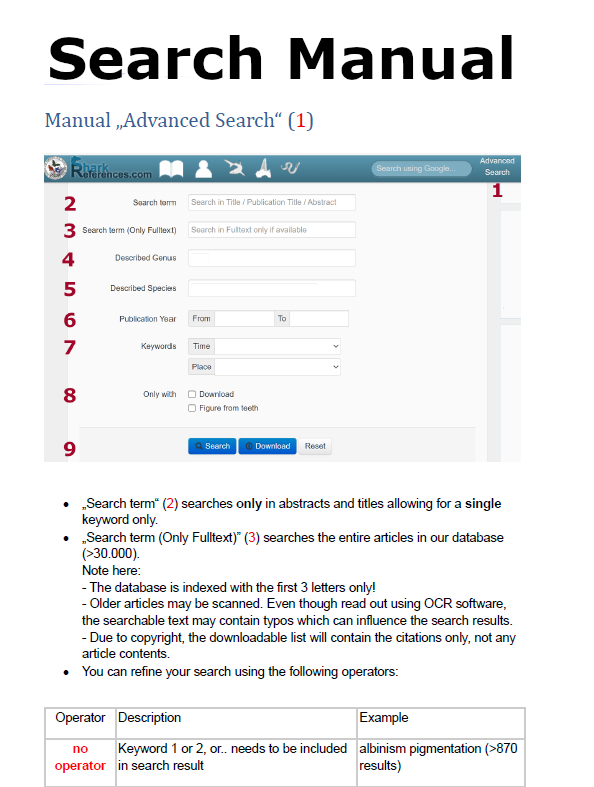
Pollerspöck, J. & Straube, N. (2025): Shark-References.com – the bibliographic database. Usage and latest search tools. [Abstract]. Book of Abstracts, 29. Jahrestagung ÖPG, Wien, 26.09.2025
Porceddu, R. & Porcu, C. & Spiga, S. & Giuliani, J. & Carrus, M. & Mulas, G. & Agus, B. & Bellodi, A. & Mulas, A. & Follesa, M.C. (2025): Allometric Brain Development and Neuroecological Adaptations in Juvenile and Adult Raja polystigma. Brain Behavior and Evolution, in press https://dx.doi.org/10.1159/000546102
Prakash, A. & Sarlin, P.J. & Thomas, J.A. (2025): Optimization of Conditions for Gelatin Extraction from Longtail Butterfly Ray, Gymnura poecilura Skin Using Response Surface Methodology (RSM). Food Analytical Methods, in press https://dx.doi.org/10.1007/s12161-025-02896-7
Purushottama, G.B. & Thomas, S. & Kizhakudan, S.J. (2025): Biology of the widenose guitarfish Glaucostegus obtusus (Muller and Henle,1841) (Rhinopristiformes: Glaucostegidae) from the eastern Arabian Sea. Indian Journal of Fisheries, 72(3), 45–57 https://dx.doi.org/10.21077/ijf.2025.72.3.154488-05
Pytka, J.M. & Bressan, G. & Antonini, C. & Barausse, A. & Barbato, M. & Dara, M. & De Santis, L.J. & Finotto, L. & Garibaldi, F. & Geraci, M.L. & Giacalone, V.M. & Gristina, M. & Lanteri, L. & Valente, G.R. & Serena, F. & Vitale, S. & Zampieri, C. & Raicevich, S. & Mazzoldi, C. (2025): Survival rates of commercial elasmobranch species: exploring post-capture release at early life stages as a fishery management measure. Journal of Environmental Management, 392, Article 126722 https://dx.doi.org/10.1016/j.jenvman.2025.126722
Rangel, B.S. & Correa, M. & Agostinho, L.S. & Borges, F. & Galvao, B. & Heithaus, M. (2025): Unexpected prey: lemon sharks (Negaprion brevirostris) observed preying on an alien invasive freshwater fish in a remote no-take marine reserve in the Equatorial Atlantic. Environmental Biology of Fishes, 108(10), 1599–1605 https://dx.doi.org/10.1007/s10641-025-01745-0
Rangel-Morales, J.M. & Ochoa-Báez, R.I. & Torres-Villegas, J.R. & Galván-Magaña, F. (2025): Distribution and morphology of the ampullae of Lorenzini in coastal and pelagic sharks from the Mexican Pacific. Regional Studies In Marine Science, 91, Article 104499 https://dx.doi.org/10.1016/j.rsma.2025.104499
Reinero, F.R. & Marsella, A. & Vitale, G. & Pacifico, A. & Mahrer, M. & Micarelli, P. (2025): Environmental Drivers of Immature Whale Shark Surface Sightings in the Gulf of Tadjoura, Djibouti. Conservation, 5, Article 68 https://dx.doi.org/10.3390/conservation5040068
Remya, L. & Thomas, S. & Muktha, M. & Kizhakudan, S.J. (2025): Incidence of pregnant endangered devil rays (Elasmobranchii: Mobulidae) from the Gulf of Mannar and Palk Bay, southeast coast of India. Current Science, 129(4), 362–369 https://dx.doi.org/10.18520/cs/v129/i4/362-369
Rigby, C.L. & Armstrong, A.O. (2025): Neotrygon yakkoei The IUCN Red List of Threatened Species 2025: e.T266886290A266886732 https://dx.doi.org/10.2305/IUCN.UK.2025-2.RLTS.T266886290A266886732.en
Rigby, C.L. & Bizzarro, J.J. & Ebert, D.A. & Rohner, C.A. (2025): Caliraja inornata The IUCN Red List of Threatened Species 2025: e.T161466A124490622 https://dx.doi.org/10.2305/IUCN.UK.2025-2.RLTS.T161466A124490622.en
Rigby, C.L. & Blanco-Parra, M.P. & Lewis, H.M.K. & Armstrong, A.O. (2025): Zapteryx exasperata The IUCN Red List of Threatened Species 2025: e.T60177A124448093 https://dx.doi.org/10.2305/IUCN.UK.2025-2.RLTS.T60177A124448093.en
Rigby, C.L. & Carlson, J. & Derrick, D. & Dicken, M. & Pacoureau, N. & Simpfendorfer, C. (2025): Carcharias taurus (amended version of 2021 assessment) The IUCN Red List of Threatened Species 2025: e.T3854A232113997 https://dx.doi.org/10.2305/IUCN.UK.2025-2.RLTS.T3854A232113997.en
Rigby, C.L. & Ebert, D.A. & Bizzarro, J.J. & Rohner, C.A. (2025): Beringraja binoculata The IUCN Red List of Threatened Species 2025: e.T44183A124429514 https://dx.doi.org/10.2305/IUCN.UK.2025-2.RLTS.T44183A124429514.en
Rigby, C.L. & Ebert, D.A. & Charles, R. (2025): Mustelus californicus The IUCN Red List of Threatened Species 2025: e.T161334A124467241 https://dx.doi.org/10.2305/IUCN.UK.2025-2.RLTS.T161334A124467241.en
Rigby, C.L. & Ebert, D.A. & Charles, R. (2025): Squatina californica The IUCN Red List of Threatened Species 2025: e.T39328A124401300 https://dx.doi.org/10.2305/IUCN.UK.2025-2.RLTS.T39328A124401300.en
Rigby, C.L. & Ebert, D.A. & Charles, R. (2025): Apristurus kampae The IUCN Red List of Threatened Species 2025: e.T44215A124430714 https://dx.doi.org/10.2305/IUCN.UK.2025-2.RLTS.T44215A124430714.en
Rigby, C.L. & Ebert, D.A. & Charles, R. (2025): Apristurus spongiceps The IUCN Red List of Threatened Species 2025: e.T44226A124432023 https://dx.doi.org/10.2305/IUCN.UK.2025-2.RLTS.T44226A124432023.en
Rigby, C.L. & Ebert, D.A. & García, E. (2025): Apristurus brunneus The IUCN Red List of Threatened Species 2025: e.T44209A124430169 https://dx.doi.org/10.2305/IUCN.UK.2025-2.RLTS.T44209A124430169.en
Rigby, C.L. & Ellis, J.R. & McCully-Phillips, S.R. & Rohner, C.A. (2025): Raja microocellata The IUCN Red List of Threatened Species 2025: e.T39400A183780223 https://dx.doi.org/10.2305/IUCN.UK.2025-2.RLTS.T39400A183780223.en
Rigby, C.L. & García, E. & Rohner, C.A. (2025): Heterodontus francisci The IUCN Red List of Threatened Species 2025: e.T39333A124401602 https://dx.doi.org/10.2305/IUCN.UK.2025-2.RLTS.T39333A124401602.en
Rigby, C.L. & Huveneers, C. & Rohner, C.A. (2025): Apristurus pinguis The IUCN Red List of Threatened Species 2025: e.T44222A124431393 https://dx.doi.org/10.2305/IUCN.UK.2025-2.RLTS.T44222A124431393.en
Rigby, C.L. & Ng, S-L & Charles, R. (2025): Etmopterus lii The IUCN Red List of Threatened Species 2025: e.T266886187A266886228 https://dx.doi.org/10.2305/IUCN.UK.2025-2.RLTS.T266886187A266886228.en
Rigby, C.L. & Pérez-Jiménez, J.C. & Ebert, D.A. & Charles, R. (2025): Mustelus henlei The IUCN Red List of Threatened Species 2025: e.T161648A124521269 https://dx.doi.org/10.2305/IUCN.UK.2025-2.RLTS.T161648A124521269.en
Rigby, C.L. & Saldaña Ruiz, L. & Rohner, C.A. (2025): Mustelus lunulatus The IUCN Red List of Threatened Species 2025: e.T161640A124519657 https://dx.doi.org/10.2305/IUCN.UK.2025-2.RLTS.T161640A124519657.en
Rincon, G. & Araújo, M.L.G. & Torres, Y.T.P. & Fernando, E. & Sayer, C. (2025): Potamotrygon henlei The IUCN Red List of Threatened Species 2025: e.T39402A2923569 https://dx.doi.org/10.2305/IUCN.UK.2025-2.RLTS.T39402A2923569.en
Roberson, L.A. & Wilcox, C. (2025): Fishery bycatch rates largely driven by variation in individual vessel behaviour. Nature Sustainability, 8(8), Article https://dx.doi.org/10.1038/s41893-025-01602-z
Robins, H. & Chapuis, L. & Kerr, C.C. & Dutka, T. & Donald, J. & Collin, S.P. (2025): The inner ear of the Port Jackson shark, Heterodontus portusjacksoni: morphometric analysis using bioimaging and phalloidin staining. Hearing Research, 466, Article 109368 https://dx.doi.org/10.1016/j.heares.2025.109368
Rochat, L. & Pollerspöck, J. & Mollen, F.H. & Sperone, E. & Reinero, F.R. & Micarelli, P. (2025): Leonard Joseph Victor Compagno (1943–2024): the greatest shark expert of the 20th century. African Journal of Marine Science, 47(3), 317–318 https://dx.doi.org/10.2989/1814232X.2025.2585609
Rodriguez-Moldes, I. & Pereira-Guldris, S. (2025): Embryonic Development of the Inner Ear of the Catshark Scyliorhinus canicula. Brain Behavior and Evolution, in press https://dx.doi.org/10.1159/000547364
Rodríguez-Moldes, I. & Sueiro, C. & Carrera, I. & Quintana-Urzainqui, I. & Candal, E. (2025): Characterization of the tyrosine-hydroxylase immunoreactive components of the basal subpallium in sharks-toward an identification of a basal subpallial complex. Frontiers In Neuroanatomy, 19, Article 1620527 https://dx.doi.org/10.3389/fnana.2025.1620527
Rohner, C.A. & Richardson, A.J. & García-Rodríguez, E. & Charles, R. & Batlle-Morera, A. & Bortoluzzi, J.R. & Mouton, T.L. & di Sciara, G.N. & Armstrong, A.O. & Everett, J.D. & Bakiu, R. & Barash, A. & Bariche, M. & Basuta, N. & Bousquet, C. & Cetkovic, I. & Giovos, I. & Guallart, J. & Milazzo, M. & Morey, G. & Aga-Spyridopoulou, R.N. & Niedermueller, S. & Serena, F. & Shakman, E. & Soldo, A. & Jabado, R.W. (2025): Important Shark and Ray Areas can inform conservation planning in the Mediterranean and Black Seas. Iscience, 28(8), Article 113192 https://dx.doi.org/10.1016/j.isci.2025.113192
Rosa, R. & Torres, Y.T.P. & Charvet, P. & Moro, G. & Sayer, C. (2025): Potamotrygon signata The IUCN Red List of Threatened Species 2025: e.T161467A889416 https://dx.doi.org/10.2305/IUCN.UK.2025-2.RLTS.T161467A889416.en
Rubin, A.M. & Walter, S.R.S. & Mohan, J.A. & Carlisle, A.B. (2025): Methods for precipitating plasma proteins for stable isotope analysis of elasmobranch blood. Journal of Experimental Marine Biology and Ecology, 592, Article 152127 https://dx.doi.org/10.1016/j.jembe.2025.152127
Ryburn, S.J. & Yu, T.M.Y. & Ong, K.J. & Wisely, E. & Alston, M.A. & Howie, E. & Leroy, P. & Giang, S.E. & Ball, W. & Benton, J. & Calhoun, R. & Favreau, I. & Gutierrez, A. & Hallac, K. & Hanson, D. & Hibbard, T. & Loflin, B. & Lopez, J. & Mock, G. & Myers, K. & Pinos-Sánchez, A. & Garcia, A.M.S. & Romero, A.R. & Thomas, A. & Williams, R. & Zaldivar, A. & Bruno, J.F. (2025): Sale of critically endangered sharks in the United States. Frontiers In Marine Science, 12, Article 1604454 https://dx.doi.org/10.3389/fmars.2025.1604454
Sagumai, J. & Samuel, R.H. & White, W.T. & Grant, M.I. (2025): Rediscovery of one of the world’s rarest sharks, the sailback houndshark Gogolia filewoodi, in Papua New Guinea. Journal of Fish Biology, in press https://dx.doi.org/10.1111/jfb.70196
Salas-Mejía, N. & Padilla-Serrato, J.G. & Balart, E.F. & Morzaria-Luna, H.N. & Ruiz-Ruiz, T.M. & Arreola-Lizárraga, J.A. (2025): Examining the Condition of Dominant Fish Populations in a Marine Protected Area in the Gulf of California. Thalassas, 41(3), Article 164 https://dx.doi.org/10.1007/s41208-025-00923-2
Sanchez, C.L. & Bunbury, N. & A’Bear, L. & Cappelli, L. & Cowin, S. & Fleisher-Dogley, F. & Jones, C.W. & Casale, P. (2025): Marine megafauna distribution and abundance at Aldabra Atoll via UAV survey. Marine Biology, 172(9), Article 142 https://dx.doi.org/10.1007/s00227-025-04686-5
Santos, C.P. & Pegado, M.R. & Santos, C.F. & Rosa, R. (2025): Studying sharks in the Anthropocene: an overview of research efforts targeting human-related threats over elasmobranchs. Reviews In Fish Biology and Fisheries, in press https://dx.doi.org/10.1007/s11160-025-09968-1
Santos, M.Q.D. & Farias, F.D.F. & Aride, P.H.R. & Oliveira, A.T. (2025): Morphology and morphometry of blood cells of two species of freshwater stingrays (Chondrichthyes: Potamotrygoninae) from the lower Solimões river, Amazon. Anais Da Academia Brasileira De Ciencias, 97(3), Article e20241149 https://dx.doi.org/10.1590/0001-3765202520241149
Sarai, E.M. & Clarke, T.M. & Colton, I.E. & Gopinath, A. & Roberts, C.N. & Huveneers, C. & Crino, O.L. (2025): Effects of capture method and handling time on the physiological stress responses of a benthic elasmobranch. Comparative Biochemistry and Physiology A-Molecular & Integrative Physiology, 310, Article 111940 https://dx.doi.org/10.1016/j.cbpa.2025.111940
Schmid, S. & Straube, N. & Albouy, C. & Delling, B. & Maclaine, J. & Matschiner, M. & Møller, P.R. & Nocita, A. & Palandačić, A. & Rüber, L. & Sonnewald, M. & Alvarez, N. & Manel, S. & Pellissier, L. (2025): Unlocking natural history collections to improve eDNA reference databases and biodiversity monitoring. BioScience, Article biaf140 https://dx.doi.org/10.1093/biosci/biaf140
Schultz, M. & Hoffmayer, E.R. & Sulikowski, J.A. & Byrne, M.E. (2025): Bycatch survival of shortfin mako sharks (Isurus oxyrinchus) in the US Atlantic pelagic longline fishery. Plos One, 20(9), Article e0330999 https://dx.doi.org/10.1371/journal.pone.0330999
Schwegler, H. & Schreiner, J. & Prüllage, M. & Lipnik, K. & Holzer, A.S. & Lewisch, E. (2025): Trouble in the Tank: A Case Report of Fatal Scuticociliate Encephalitis in a Whitetip Reef Shark (Triaenodon obesus). Journal of Fish Diseases, in press https://dx.doi.org/10.1111/jfd.70046
Seifert, J. (2025): Tooth morphology of the Pacific spadenose shark Scoliodon macrorhynchos (Chondrichthyes: Carcharhinidae) with evidence of its diet. Veröffentlichungen Museum für Naturkunde Chemnitz, 48, 207–210
Setyawan, E. & Hasan, A.W. & Malaiholo, Y. & Sianipar, A.B. & Mambrasar, R. & Meekan, M. & Gillanders, B.M. & D’Antonio, B. & Putra, M.I.H. & Erdmann, M.V. (2025): Insights into the population demographics and residency patterns of photo-identified whale sharks Rhincodon typus in the Bird’s Head Seascape, Indonesia. Frontiers In Marine Science, 12, Article 1607027 https://dx.doi.org/10.3389/fmars.2025.1607027
Sharikin, A.S.A.A. & Mohamad, A. & Fadzli, M.H. & Azimi, W.M.A.W. & Adam, S. & Nasir, A. & Piah, R.M. (2025): Insights on Diversity and Exploitation of Sharks and Rays in the East Coast of Peninsular Malaysia. Thalassas, 41(3), Article 150 https://dx.doi.org/10.1007/s41208-025-00906-3
Shocklee, M. & Russell, J. & Herrick, K. & Schmitt, T.L. & Robeck, T.R. & Papich, M.G. (2025): Pharmacokinetics of Ceftazidime After a Single Intramuscular Dose in Whitespotted Bamboo Sharks (Chiloscyllium plagiosum). Journal of Veterinary Pharmacology and Therapeutics, in press https://dx.doi.org/10.1111/jvp.70031
Smith, A.B. & Landesman, J. & Williamson, L. & Sun, P.Y. (2025): Interaction with enrichment objects depends on color and increases after feeding in some elasmobranchs but not others. Applied Animal Behaviour Science, 292, Article 106829 https://dx.doi.org/10.1016/j.applanim.2025.106829
Soldo, A. & Turan, C. (2025): Decreasing Trend of Great White Shark Carcharodon carcharias Records in the Mediterranean: A Significant Population Loss or Shifts in Migration Patterns? Journal of Marine Science and Engineering, 13(9), Article 1704 https://dx.doi.org/10.3390/jmse13091704
Staggl, M.A. & Villalobos-Segura, E. & Benton, M.J. & Kriwet, J. (2025): Global environmental drivers shape Cenozoic neoselachian diversity and identify modern conservation priorities Scientific Reports, 15, Article 38661 https://dx.doi.org/10.1038/s41598-025-25653-6
Taglioni, F. & Guiltat, S. & Delsaut, M. & Tirard, P. & Payet, D. (2025): Variability of environmental, contextual and individual factors in human-shark interactions in New Caledonia, 1980-2022, with some comparisons to Reunion Island. Scientific Reports, 15(1), Article 30750 https://dx.doi.org/10.1038/s41598-025-11788-z
Tavera, J. & Arias, J.D. & Ossa-Hernández, N. (2025): Ichthyological reference collection of the Universidad del Valle (Cali, Colombia): a reservoir of Colombia’s fish diversity. Biological Journal of The Linnean Society, 146(1), Article blaf060 https://dx.doi.org/10.1093/biolinnean/blaf060
Tokunaga, S. & Chiang, W.C. & Nakamura, I. & Matsumoto, R. & Watanabe, Y.Y. (2025): Enhanced thermoregulation abilities of shortfin mako sharks as the key adaptive significance of regional endothermy in fishes. Journal of Animal Ecology, in press https://dx.doi.org/10.1111/1365-2656.70116
Toomey, L. & Bellodi, A. & Bottaro, M. & Consiglio, A. & Fiocchi, E. & Soncin, M. & Bertazzo, V. & Follesa, M.C. & Manfrin, A. & Niedermüller, S. & Prato, G. & Carbonara, P. (2025): Unveiling the biochemical and haematological profile of blue shark (Prionace glauca) in the Mediterranean after bycatch. Conservation Physiology, 13(1), Article coaf067 https://dx.doi.org/10.1093/conphys/coaf067
Toomey, L. & Bellodi, A. & Bottaro, M. & Consiglio, A. & Fiocchi, E. & Soncin, M. & Bertazzo, V. & Follesa, M.C. & Manfrin, A. & Niedermüller, S. & Prato, G. & Carbonara, P. (2025): Unveiling the biochemical and haematological profile of blue shark (Prionace glauca) in the Mediterranean after bycatch. Conservation Physiology, 13(1), Article coaf067 https://dx.doi.org/10.1093/conphys/coaf067
Torres, G.A.& Martins, R.S. & Fischer, L.G. & Cardoso, L.G. & Sant’Ana, R. & Mourato, B. (2025): Age and growth of the endemic groovebelly stingray (Dasyatis hypostigma), a heavily exploited batoid in the Brazilian Meridional Margin (21–34°S). Journal of Fish Biology, in press https://dx.doi.org/10.1111/jfb.70305
Torres, Y.T.P. & Araújo, M.L.G. & Sayer, C. & Charvet, P. (2025): Potamotrygon motoro The IUCN Red List of Threatened Species 2025: e.T39404A2923869 https://dx.doi.org/10.2305/IUCN.UK.2025-2.RLTS.T39404A2923869.en
Torres, Y.T.P. & Araújo, M.L.G. & Sayer, C. & Charvet-Almeida, P. (2025): Potamotrygon orbignyi The IUCN Red List of Threatened Species 2025: e.T161609A892617 https://dx.doi.org/10.2305/IUCN.UK.2025-2.RLTS.T161609A892617.en
Torres, Y.T.P. & Charvet, P. & Araujo, M.L. & Sayer, C. (2025): Potamotrygon tigrina The IUCN Red List of Threatened Species 2025: e.T58431796A124550267 https://dx.doi.org/10.2305/IUCN.UK.2025-2.RLTS.T58431796A124550267.en
Torres, Y.T.P. & Charvet, P. & Rosa, R. (2025): Potamotrygon boesemani The IUCN Red List of Threatened Species 2025: e.T188065333A273588295 https://dx.doi.org/10.2305/IUCN.UK.2025-2.RLTS.T188065333A273588295.en
Torres, Y.T.P. & Góes de Araújo, M.L. & Sayer, C. & Charvet, P. (2025): Potamotrygon humerosa The IUCN Red List of Threatened Species 2025: e.T161323A124465686 https://dx.doi.org/10.2305/IUCN.UK.2025-2.RLTS.T161323A124465686.en
Torres, Y.T.P. & Góes de Araújo, M.L. & Sayer, C. & Charvet, P. (2025): Paratrygon orinocensis The IUCN Red List of Threatened Species 2025: e.T214418453A214418464 https://dx.doi.org/10.2305/IUCN.UK.2025-2.RLTS.T214418453A214418464.en
Torrico-Destre, H. & Careaga, M. & Carvajal-Vallejos, F.M. (2025): Bolivian Freshwater Stingrays (Potamotrygonidae): Species Characterization and Taxonomic Knowledge Update. Journal of Ichthyology, in press https://dx.doi.org/10.1134/S0032945224602811
Trevail, A.M. & Dunn, R.E. & Carr, P. & Esteban, N. & Freeman, R. & Harris, J.L. & Nicoll, M.A.C. & Stephens, N. & Stevens, G.M.W. & Votier, S.C. & Wood, H. & Hays, G.C. (2025): Large marine protected areas can encompass movements of diverse megafauna. Journal of Applied Ecology, 62(9), 2454–2463 https://dx.doi.org/10.1111/1365-2664.70117
Trujillo, J.E. & Bouyoucos, I.A. & Weideli, O.C. & Milanesi, E.M.C. & Debaere, S.F. & Rayment, W.J. & Planes, S. & Domenici, P. & Rummer, J.L. & Allan, B.J.M. (2025): Safety in the shallows: nearshore coastal habitats can provide physical and thermal features that optimize escape performance in newborn blacktip reef sharks (Carcharhinus melanopterus). Conservation Physiology, 13(1), Article coaf045 https://dx.doi.org/10.1093/conphys/coaf045
Tuthill-Christensen, G.A. & Jungbluth, M.J. & Crow, K.D. (2025): Elusive and vulnerable: evaluating spatial and temporal variation in the distribution of manta rays around O’ahu using environmental DNA. Frontiers In Marine Science, 12, Article 1655518 https://dx.doi.org/10.3389/fmars.2025.1655518
Vajas, P. & Ricouard, A. & Lecomte, J.B. & Brind’Amour, A. & Laffargue, P. & Mahevas, S. (2025): Description of the monthly spatial dynamics of commercial and bycatch demersal species in the Bay of Biscay. Scientific Data, 12(1), Article 1585 https://dx.doi.org/10.1038/s41597-025-05869-x
Valenzisi, B. & Gaston, T.F. & Parsons, M. & Huggett, M.J. & Harasti, D. (2025): Assessing the soundscapes of the critically endangered grey nurse shark (Carcharias taurus) in rocky reef habitats. Marine Environmental Research, 211, Article 107438 https://dx.doi.org/10.1016/j.marenvres.2025.107438
Vase, V.K. & Kumar, R. & Rahangdale, S. & Azeez, A. & Jaysree, G. & Vipul, S. & Jayaraman, J. & Zacharia, P.U. (2025): Evaluating the status of marine fishery resources along the Gujarat coast of India: A productivity and susceptibility analysis. Fisheries Research, 291, Article 107542 https://dx.doi.org/10.1016/j.fishres.2025.107542
Vázquez-Aguilar, C.I. & Santana-Morales, O. & Alvarez-Sánchez, L.F. & Malpica-Cruz, L. (2025): The use of acoustic and satellite telemetry to study elasmobranchs in Latin America: past efforts and future directions. Ciencias Marinas, 51, Article e3541 https://dx.doi.org/10.7773/cm.y2025.3541
Vázquez-Moreno, R.A. & Tripp-Valdez, A. & Galván-Magaña, F. & Elorriaga-Verplancken, F.R. & Klimley, A.P. & Delgado-Huertas, A. (2025): Trophic ecology of banded guitar ray Zapteryx exasperata (Jordan & Gilbert, 1880) during El Niño and The Blob in the Mexican Pacific. Environmental Biology of Fishes, 108(11), 1717–1737 https://dx.doi.org/10.1007/s10641-025-01756-x
Volvenko, I.V. & Vinnikov, A.V. & Terentiev, D.A. & Orlov, A.M. (2025): Elasmobranch bycatch in Russian fisheries in the Pacific Ocean. Ices Journal of Marine Science, 82(9), Article fsaf157 https://dx.doi.org/10.1093/icesjms/fsaf157
Webber-Schultz, A. & Flammang, B. & Hall, K. & Simonitis, L. (2025): Who Nose What Flows: Shark Narial Denticle Morphology and Hydrodynamic Implications. Integrative and Comparative Biology, in press https://dx.doi.org/10.1093/icb/icaf104
Werner, L. & Ventura, A.D.B. & Fragoso, A.B.L. & Silva, D.M.R.E. & Silva, F.J.D. & Leitao, H.C.D.E.S. & de Oliveira, R.E.M. & Gavilan, S.A. & de Farias, D.S.D. (2025): Stranding of a filter-feeding giant: a case report of Whale shark (Rhincodon typus) in the Southwestern Equatorial Atlantic. Biota Neotropica, 25(3), Article e20251791 https://dx.doi.org/10.1590/1676-0611-BN-2025-1791
Werry, J.M. & Meager, J.J. (2025): An ecological risk assessment for the impacts of offshore wind farms on sharks and rays in Australia. Global Ecology and Conservation, 62, Article e03806 https://dx.doi.org/10.1016/j.gecco.2025.e03806
Wetherbee, B.M. & Harvey, G.M.C. & Kresge, C.D. & Brantley, M.K. & Fleischer, O.W. & Kobasa, N.A. & Vaudo, J.J. & Shivji, M.S. (2025): Movements of Galapagos Sharks (Carcharhinus galapagensis) in Eastern Tropical Pacific Waters off Central and South America. Fishes, 10(9), Article 459 https://dx.doi.org/10.3390/fishes10090459
Williams, C.T. & McIvor, A.J. & Richardson, E.B. & Lea, J. & Clarke, C.R. & Cochran, J.E.M. & Kattan, A. & Ormond, R. & Berumen, M.L. (2025): Elevated sea surface temperatures drive greater seasonal depth use in a baited aggregation of silky sharks Carcharhinus falciformis. Marine Ecology Progress Series, 773, 115–128 https://dx.doi.org/10.3354/meps14966
Winton, M.V. & Novak, A.J. & Migneco, V.L. & Chisholm, J. & Skomal, G.B. (2025): Dusky sharks actively prey on gray seals. Environmental Biology of Fishes, in press https://dx.doi.org/10.1007/s10641-025-01736-1
Wosnick, N. & Wilfong, H. & Dörfer, T. & Bakke, A.H. & Kemunto, D. & McKinney, A. & Olariaga, B. & Cornfield, B. (2025): Little Protectors of Big Predators: Empowering Youth for Shark Conservation in The Bahamas. Animal Conservation, in press https://dx.doi.org/10.1111/acv.70031
Xie, J. & Luo, W.P. & Yang, J.W. & Wang, C.X. & Li, Y. (2025): Transformer partial discharge signal adaptive denoising method based on white shark optimization optimized successive variational mode decomposition. Review of Scientific Instruments, 96(9), Article 94701 https://dx.doi.org/10.1063/5.0279828
Xie, J.Y. & Xiao, Y.J. & Zhang, Y.B. & Hong, A. & Chen, X.J. (2025): Identification and functional analysis of a novel potent anti-angiogenesis peptide SAIF-B2 derived from shark cartilage. European Journal of Pharmacology, 1004, Article 177961 https://dx.doi.org/10.1016/j.ejphar.2025.177961
Yang, K. & Wang, C.M. & Jiang, L. & Fang, R.C. & Dong, Z.C. (2025): Bioinspired Swimming Robots with 3D Biomimetic Shark Denticle Structures for Controlled Marangoni Propulsion. Biomimetics, 10(8), Article 479 https://dx.doi.org/10.3390/biomimetics10080479
Yoo, Y.J. & An, S.Y. & Lee, S.H. & Lee, S.J. & Gwak, W.S. (2025): Spatiotemporal Patterns of Fish Diversity in the Waters Around the Five West Sea Islands of South Korea: Integrating Bottom Trawl and Environmental DNA (eDNA) Methods. Animals, 15(17), Article 2613 https://dx.doi.org/10.3390/ani15172613
Zea-De La Cruz, H. & Meiners-Mandujano, C. & Tovar-Avila, J. & Jiménez-Badillo, L. & Oviedo-Pérez, J.L. (2025): Length-weight relationships of eleven demersal ray and shark species (Elasmobranchii) from the southern Gulf of Mexico. Acta Ichthyologica Et Piscatoria, 55, 191–195 https://dx.doi.org/10.3897/aiep.55.156837
Zemah-Shamir, S. (2025): Protecting sharks by protecting places: a call to regulate aggregation zones. Journal For Nature Conservation, 89, Article 127117 https://dx.doi.org/10.1016/j.jnc.2025.127117
Zhang, B. & Feng, Y.D. & Lv, M.Q. & Jia, L. & Liao, Y.G. & Xu, X.Y. & Meyer, A. & Sun, J.S. & Fan, G.Y. & Li, Y.M. & Zhang, Y.L. & Zhao, N. & Li, Y.K. & Bao, B.L. (2025): Adaptive loss of shortwave-sensitive opsins during cartilaginous fish evolution. Nature Communications, 16(1), Article 7684 https://dx.doi.org/10.1038/s41467-025-62544-w
Zhang, X. & Tinacci, L. & Giusti, A. & Kang, H.R. & Li, S.H. & Deng, W.D. & Li, Y. & Sun, Z.Z. & Peng, H.Y. & Zou, L. & Li, X.J. & Armani, A. & Wen, J. (2025): Face-off: Shark or pork? DNA barcoding authentication and labelling analysis of shark products (intestine and stomach) available on Chinese e-commerce. Food Control, 180, Article 111685 https://dx.doi.org/10.1016/j.foodcont.2025.111685
Extinct Chondrichthyes:
Abd-Elhameed, S. & Abd-Elhameed, M. (2025): Qualitative and quantitative analyses of Middle Eocene odontaspidid shark (Brachycarcharias) from Wadi Garawi area, north Eastern Desert, Egypt. Advances in Basic and Applied Sciences, 5(1), 21–28 https://dx.doi.org/10.21608/abas.2025.403624.1068
Andreev, P.S. & Zhu, M. & Brakenhoff, L. & Li, Q. & Zhao, W.J. & Peng, L.J. & Marone, F. & Dearden, R.P. & Rücklin, M. (2025): The shoulder girdle of early chondrichthyans grew by skeletal remodelling. Biology Letters, 21(9), Article 20250411 https://dx.doi.org/10.1098/rsbl.2025.0411
Baur, H. & Kriwet, J. & Feichtinger, I. (2025): New insight into the deep marine elasmobranch diversity of the Central Paratethys Sea during the early Aquitanian of Austria. [Abstract]. Book of Abstracts, 29. Jahrestagung ÖPG, Wien, 26.09.2025
Bazzi, M. & Siversson, M. & Wintner, S. & Newbrey, M. & Payne, J.L. & Campione, N.E. & Roberts, A.J. & Natanson, L.J. & Hall, S. & Blake, T. & Kear, B.P. (2025): Early gigantic lamniform marks the onset of mega-body size in modern shark evolution. Communications Biology, 8, Article 1499 https://dx.doi.org/10.1038/s42003-025-08930-y
Begat, A. & Villalobos-Segura, E. & Jambura, P.L. & Staggl, M.A. & Klug, S. & Kriwet. J. (2025): Review of the dental pattern in the squalomorph shark Protospinax annectans, and a description of two new Jurassic shark genera. Acta Palaeontologica Polonica, 70(4), 731–748 https://dx.doi.org/10.4202/app.01260.2025
Benavides-Cabra, C.D. & Páramo-Fonseca, M.E. & Narváz-Rincón, J.A. & Pomar, D.E. (2025): A large lamniform shark from the Aptian of Villa de Leiva (Boyaca, Colombia), based on the first Lower Cretaceous shark specimen preserving both teeth and vertebrae. Cretaceous Research, 178, Article 106211 https://dx.doi.org/10.1016/j.cretres.2025.106211
Burrow, C.J. & Turner, S. & Itano, W.M. & Den Blaauwen, J.L. & Stewart, S. (2025): Cynopodius, a long-toothed chondrichthyan from the Carboniferous of Scotland and the USA. Earth and Environmental Science Transactions of The Royal Society of Edinburgh , in press https://dx.doi.org/10.1017/S1755691025100777
Calzoni, P. & Amadori, M. & Amalfitano, J. & Roghi, G. & Serafini, G. & Zivelonghi, F. & Zorzin, R. & Giusberti, L. (2025): How Excavation Activity is both a Blessing and a Curse for the Palaeontological Heritage: The Case Study of the Fossils from the Lastame in the Verona Province (Northern Italy). Geoheritage, 17(4), Article 141 https://dx.doi.org/10.1007/s12371-025-01184-4
Cañete-Cañete, N.G. & Villafaña, J.A. & Farias, L. & Gayo, E.M. & Rivadeneira, M.M. (2025): The fossil record of chondrichthyans (Elasmobranchii, Holocephali) from the Cretaceous-Eocene in Chile: diversity and palaeobiogeographic implications. Historical Biology, in press https://dx.doi.org/10.1080/08912963.2025.2530141
Cicimurri, D.J. & Stringer, G.L. & Ebersole, J.A. (2025): Additional records of Paleogene fishes (Chondrichthyes and Osteichthyes) from Alabama, USA. Acta Geologica Polonica, 75(4), Article e60 https://dx.doi.org/10.24425/agp.2025.155954
Cohen, K.E. & Coates, M.I. & Fraser, G.J. (2025): Teeth outside the jaw: Evolution and development of the toothed head clasper in chimaeras. Proceedings of the National Academy of Sciences, 122(37), Article e2508054122 https://dx.doi.org/10.1073/pnas.2508054122
Collareta, A. & Mezzasalma, O. & Agresti, J. & Barucci, A. & Bosio, G. & Mulè, F. & Casati, S. & Di Cencio, A. & Bianucci, G. & Pieri, A. & Nobile, F. (2025): Trace fossil evidence for Osedax Rouse et al., 2004 exploiting shark tooth dentine on a Pliocene seafloor: broadening our understanding of a major taphonomic agent. Fossil Record, 28(2), 359–375 https://dx.doi.org/10.3897/fr.28.167615
Dubikovska, A. & Górka, M. & Kovalchuk, O. & Bienkowska-Wasiluk, M. & Świdnicka, E. & Barkaszi, Z. (2025): Middle Miocene (Badenian) fishes from the north-west of the Fore-Carpathian Basin. Swiss Journal of Palaeontology, 144, Article 65 https://dx.doi.org/10.1186/s13358-025-00408-y
Egli, H.C. & Goode, B. & Rempert, T. & Rego, C. (2025): Pseudocorax (Chondrichthyes, Lamniformes, Pseudocoracidae) in the Upper Maastrichtian phosphates of Khouribga Province, Morocco. Journal of Paleontology, in press https://dx.doi.org/10.1017/jpa.2025.10183
Feichtinger, I. & Beaury, B. & Coric, S. & Guinot, G. & Harzhauser, M. & Nichterl, T. & Pollerspöck, J. & Stoykova, K. (2025): Reconstructing fish diversity across the K–Pg Boundary: Insights from bulk sampling in Austria and Bulgaria. [Abstract]. Book of Abstracts, 29. Jahrestagung ÖPG, Wien, 26.09.2025
Fischer, J. & Johns, M.J. & Makahnouk, W.R.M. & Nyborg, T. & Deom, E. & Bowen, D. & Bartlett, R. (2025): A late Eocene rhinochimaeroid egg capsule from marine coastal strata of British Columbia, Canada. [Abstract]. Book of Abstracts, Geo4Göttingen 2025, Göttingen, Germany, 14 - 18 September 2025
Fischer, J. & Spindler, F. & Neumann, E. & Schindler, T. & Voigt, S. (2025): The fossil egg capsule Palaeoxyris - Indirect evidence of hybodontid sharks in the Late Paleozoic Remigiusberg Formation, Saar-Nahe Basin, Germany. [Abstract]. Book of Abstracts, Geo4Göttingen 2025, Göttingen, Germany, 14 - 18 September 2025
Goedert, J.L. & Anderson, K.L. & Burns, C. & Kiel, S. (2025): Fossils of the megatoothed shark Otodus (Chondrichthyes, Lamniformes) from Washington State, USA. https://dx.doi.org/10.1007/s12542-025-00758-5
Greenfield, T. (2025): Notes on the nomenclature of spinorays (Chondrichthyes, Batomorphii, Apolithabatiformes). Bionomina, 43, 1–13 https://dx.doi.org/10.11646/bionomina.43.2.2
Höltke, O. & Lechner, T.S. & Gold-Lechner, I.M. & Rasser, M.W. (2025): New additions and expanded insights into the elasmobranch fauna of the Upper Marine Molasse (Ottnangian, Lower Miocene) of Ursendorf and Rengetsweiler (Baden-Württemberg, SW Germany). Neues Jahrbuch für Geologie und Paläontologie - Abhandlungen, 316(1), 1–21 https://dx.doi.org/10.1127/njgpa/1280
Ivanov, A.O. & Hu, K.Y. (2025): New fish assemblages from the Carboniferous deep-water sections of South China and Western Kazakhstan. Journal of Paleontology, in press https://dx.doi.org/10.1017/jpa.2025.10134
Kogan, I. & Fischer, J. & Schneider, J.W. & Rößler, R. & Werneburg, R. (2025): The late Viséan Chemnitz fossil site – a Carboniferous locality full of surprises. [Abstract]. Book of Abstracts, Geo4Göttingen 2025, Göttingen, Germany, 14 - 18 September 2025
Lambert, O. & Van Boeckel, J. & Bosselaers, M. & Gijsen, B. & Van Rompaey, P. & Everaert, S. (2025): A tiny dolphin (Cetacea, Odontoceti, Kentriodontidae) cranium from the Middle Miocene of the southern North Sea with a rare osteological malformation. Geologica Belgica, 28(1–2), 79–91 https://dx.doi.org/10.20341/gb.2025.009
Landau, B.M. & Hovestadt, D.C. & Silva, C.M.D. (2025): A new chondrichthyan (Sharks and Rays) Fossil Assemblage from the Miocene Cacela Fm. at Albufeira (Algarve, Portugal) with two new species: Palaeoecology and Biogeography. Zootaxa, 5724(1), 1–66 https://dx.doi.org/10.11646/zootaxa.5724.1.1
Lopes, R.P. & Pereira, J.C. (2025): Contribution to the knowledge of fossil fishes (Chondrichthyes and Actinopterygii) from Quaternary deposits of the Pelotas Basin, Southern Brazil. Revista Brasileira De Paleontologia, 28(1), Article e20250495 https://dx.doi.org/10.4072/rbp.2025.1.0495
Maisch, H.M. & Becker, M.A. & Perez, V.J. & Shimada, K. (2025): Sharks and rays (Chondrichthyes: Elasmobranchii) from the Peace River and Tamiami formations (Late Miocene–Early Pliocene) on the submerged continental shelf near Venice, Florida, USA. Palaeontologia Electronica, 28(3), Article a49 https://dx.doi.org/10.26879/1529
Numberger-Thuy, L.D. & Delsate, D. & Poschmann, M.J. & Schindler, T. & Thuy, B. (2025): A new phytosaur-dominated vertebrate assemblage from the Late Triassic of the South Eifel region (Rhineland-Palatinate, Germany). Neues Jahrbuch Fur Geologie Und Palaontologie-Abhandlungen, 315(2), 187–208 https://dx.doi.org/10.1127/njgpa/1273
Otero, R.A. (2025): New Paleogene records of cartilaginous fishes (Chondrichthyes) from central Chile, including the oldest lamnid diversity from the southeastern Pacific. PeerJ, 13, Article e19996 https://dx.doi.org/10.7717/peerj.19996
Partarrieu, D. & Pinto, L. & Garcia, C. & de los Arcos, S. & Gonza, M. & Solís-Pichardo, G. & Arrieta-García, G. & Hernández-Treviño, T. & Schaaf, P. & Fonseca, F. & Mourgues, F.A. & Oyanadel-Urbina, P. & Chávez-Hoffmeister, M. & Carrillo-Briceño, J.D. & Flores-Aqueveque, V. & Zambrano-Lobos, P. & Ortega, C. & Rivadeneira, M.M. (2025): Plio-Pleistocene water cooling in the southeastern Pacific Ocean: Insights from paleoecology, marine sedimentary facies analysis, and Sr isotope stratigraphy at Coquimbo (∼30°S), Chile. Journal of Palaeogeography, 14(4), Article 100269 https://dx.doi.org/10.1016/j.jop.2025.100269
Peecook, B.R. & Sidor, C.A. & Mcintosh, J.A. & Viglietti, P.A. & Smith, R.M.H. & Tabor, N.J. & Kammerer, C.F. & Lungmus, J.K. & Museba, J. & Tolan, S. & Whitney, M.R. & Angielczyk, K.D. (2025): Successive assemblages of upper Permian vertebrates in the upper Madumabisa Mudstone Formation of the Luangwa Basin, Zambia. Journal of Vertebrate Paleontology, 45, Article e2486065 https://dx.doi.org/10.1080/02724634.2025.2486065
Popov, E. V. & Zenina, Y.V, (2025): First Record of Chimaeroid Fish (Holocephali: ’Edaphodontidae’) from the Lower Cretaceous of the Middle Volga Region. Izvestiya of Saratov University. Earth Sciences, 25(3), 201–210 (in Russian) https://dx.doi.org/10.18500/1819-76632025-25-3-201-210
Reichenberg, M. & Lehman, J. & Feichtinger, I. (2025): Palaeoecology of the Miocene fish fauna of St. Margarethen, Austria. [Abstract]. Book of Abstracts, 29. Jahrestagung ÖPG, Wien, 26.09.2025
Rondelli, R. (2025): Ptychodus latissimus (Agassiz, 1835) nel Cretaceo della Valle del Panaro (Appennino modenese). Atti della Società dei naturalisti e matematici di Modena, 156, 45–63
Rondelli, R. (2025): Il grande squalo bianco Carcharodon carcharias (Linnaeus, 1758) nel Pliocene di Vignola (Appennino modenese). Atti della Società dei naturalisti e matematici di Modena, 156, 85–109
Rubin, L.D. & Fraser, G.J. & Gabler-Smith, M.K. & Lauder, G.V. & Ribeiro, W.V. & Vaz, D.F.B. & Wallis-Mauro, N. & Sibert, E.C. (2025): Quantifying the Denticle Multiverse: A Standardized Coding System to Capture Three Dimensional Morphological Variations for Quantitative Evolutionary and Ecological Studies of Elasmobranch Denticles. Integrative Organismal Biology, 7(1), Article obaf021 https://dx.doi.org/10.1093/iob/obaf021
Singh, N.A. & Sharma, K.M. & Patnaik, R. & Tiwari, R.P. & Kathal, P.K. & Singh, N.P. & Singh, Y.P. & Choudhary, A.D. (2025): Additional late Miocene sharks and batoids (Chondrichthyes, Elasmobranchii) from Baripada Beds, Odisha, India: Implications for palaeoenvironment and palaeobiogeography. Journal of the Palaeontological Society of India, in press https://dx.doi.org/10.1177/055293602513767
Vida, T.P. & Kriwet, J. & Martin, T. (2025): A taxonomic and paleoecological review of the Rhaetian chondrichthyan fauna of Bonenburg (NRW) Germany. Paläontologische Zeitschrift, in press https://dx.doi.org/10.1007/s12542-025-00744-x
Villafaña, J.A. & Campos-Medina, J. & Chávez-Hoffmeister, M.F. & Araya, S. & Araya, B. & Ledezma, L. & Hernandez, Y. & Ramos-Rojas, H.A. & Bolomey, J. & Tejo, M. & Vera, F. & Campoy, A.N. & Arotaipe, R. & Bugueño, Y. & Antiquera, B. & Rivadeneira, M.M. (2025): Diving into the past: a new assemblage of Neogene elasmobranch microfossils from the eastern Pacific of South America. Papers in Palaeontology, 11(6), 1–25 https://dx.doi.org/10.1002/spp2.70043
Volosky, D. & Moisan, P. & Lara, M.B. & Schneider, J.W. & Scholze, F. & Espinoza, M. & Schmitz, O. & Aguilar, M. & Morales, D. & Flores, M. & Contreras, J. & Frenzel, P. (2025): A Late Triassic biota from a rift-lake system in southwestern Gondwana (Atacama Desert, Northern Chile). Palaeogeography Palaeoclimatology Palaeoecology, 679, Article 113328 https://dx.doi.org/10.1016/j.palaeo.2025.113328
Parasites:
Caira, J.N. & Bueno, V.M. & Jensen, K. (2025): Sisters Parasitizing Sisters: On the Onchobothriidean Tapeworms of Hammerhead and Requiem Sharks. Journal of Parasitology, 111(4), 532–570 https://dx.doi.org/10.1645/24-101
Hanselman, K.M. & Gobiraj, R. & Jensen, K. (2025): Revision of the Lecanicephalidean Genus Flapocephalus Deshmukh, 1979 (Eucestoda) from Cowtail Rays (Genus Pastinachus Rüppell) (Myliobatiformes: Dasyatidae Jordan and Gilbert) with the Description of Four New Species. Journal of Parasitology, 111(5), 582–605 https://dx.doi.org/10.1645/24-92
Irigoitia, M.M. & Franzese, S. & Alarcos, A.J. & Arredondo, N.J. & Timi, J.T. (2025): An unusual new species at risk, parasite of a critically endangered guitarfish, Pseudobatos horkelii (Elasmobranchi: Rhinobatidae): insights into the phylogeny of Acanthobothrium (Cestoda: Onchoproteocephalidea). Zoologischer Anzeiger, 318, 120–131 https://dx.doi.org/10.1016/j.jcz.2025.07.008
Kita, Y. & Nitta, M. & Abe, H. & Kaburagi, S. & Fujita, T. & Toyota, K. & Kondo, Y. & Kajihara, H. (2025): A new species of Pseudoacanthocephalus (Acanthocephala: Pseudoacanthocephalidae) from Sado Island, Japan, with a report of its accidental occurrence in a marine elasmobranch. Folia Parasitologica, 72, Article 28 https://dx.doi.org/10.14411/fp.2025.028
Ksepka, S.P. & Newton, A.L. & Bullard, S.A. (2025): Meningoencephalitis in Stranded Smooth Dogfish (Mustelus canis) Infected by Philasterides dicentrarchi (Philasterida: Philasteridae) in the Northwestern Atlantic Ocean. Journal of Parasitology, 111(4), Article https://dx.doi.org/10.1645/24-147
Maghraoui, K. & Boulajfene, W. & Bahri, S. (2025): Cestode parasites of Squalus megalops and Raja radula as metal contamination indicators in the northern and the southern seawaters of Tunisia. Aquatic Ecology, in press https://dx.doi.org/10.1007/s10452-025-10236-4
Montes, M.M. & Castro-Romero, R. & Bovcon, N. & Ostoich, N. & Valerga, E. & Theiller, M. & Balcazar, D. (2025): Evidence from integrative taxonomy reveals non-monophyly in Pseudocharopinus (Copepoda: Lernaeopodidae), with description of a new species from the Southwestern Atlantic. Systematic Parasitology, 102(6), Article 56 https://dx.doi.org/10.1007/s11230-025-10251-x
Morales-Serna, F.N. (2025): Global patterns of modularity and narrow host use in fish-parasitic copepods (Crustacea). Biodiversity Data Journal, 13, Article e163693 https://dx.doi.org/10.3897/BDJ.13.e163693
Oliva, M.E. & Nacari, L.A. & Espinola-Novelo, J.F. & Escribano, R. (2025): Metazoan Parasite Communities of Two Sympatric Shortnose Chimeras (Holocephali: Chimaeridae) from Deep Waters Associated with the Humboldt Current System: Ancient Fishes Harbor Ancient Parasites. Diversity, 17(9), Article 601 https://dx.doi.org/10.3390/d17090601
Poddubnaya, L.G. & Kuchta, R. & Scholz, T. (2025): First Record of Phyllobothriid Metacestodes in Chimaera monstrosa (Holocephali) and Oncorhynchus gorbuscha (Salmonidae): Novel Insight into Larval Topography and Ultrastructure. Journal of Parasitology, 111(4), Article https://dx.doi.org/10.1645/24-136
Trindade, P.A.A. & Silva, F.A. & Oliveira, M.S.B. & Jeffres, C.A. & Andrade, M. & Giarrizzo, T. (2025): First report of Vandellia sp. parasiting the Raspy river stingray Potamotrygon scobina in the Amazon basin. Revista Brasileira De Parasitologia Veterinaria, 34(2), Article e017624 https://dx.doi.org/10.1590/S1984-29612025011 |