|
|
|
|
NEWSLETTER 8+9/2025 07.09.2025
|
|
|
Please acknowledge use of the database www.shark-references.com in your publications, and cite:
Pollerspöck, J. & Straube, N. 2025, Bibliography database of living/fossil sharks, rays and chimaeras (Chondrichthyes: Elasmobranchii, Holocephali), www.shark-references.com, World Wide Web electronic publication, Version 2025 |
|
|
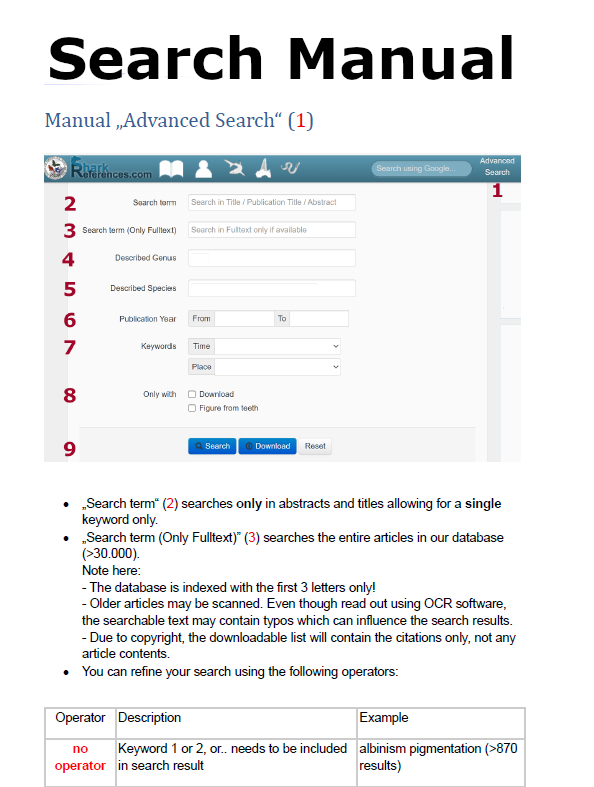
Shark reference custom search tool Phase 1+2 concluded (05.09.2025)! We have great news for our users who need custom keyword searches: the new software is now working perfectly. To help you get started with the new full-text search, we have published a manual. It's available for download on our website and via ResearchGate. We would like to extend a heartfelt thank you to all our donors and hope you will make good use of this new feature. Fins up, Jürgen & Nico
------------------------------------------------------------------------------------------------------------------------
New publications authored by N. Straube and J. Pollerspöck, team shark-references!  This study reports on a rare assemblage of deep-marine elasmobranchs from the middle Badenian (Langhian) of Austria, which has been recovered by extensive bulk sampling of sediment deposited in the Krems embayment. The applied multidisciplinary approach enabled an age assignment, placing the assemblage around the mid Badenian flooding event (14.59 ± 0.2 Ma). Palaeoenvironmental reconstruction, based on a well-preserved foraminifera assemblage and fish otoliths, indicates predominantly oxic to suboxic with partially dysoxic conditions of a rather deep-marine (>100 m) setting, which align with the recovered elasmobranch taxa. Feichtinger, I. & Weinmann, A.E. & Harzhauser, M. & Schwarzhans, W. & Golebiowski, R. & Pollerspöck, J. 2025 Deep-marine elasmobranchs from the Badenian (Langhian, Middle Miocene) of the Central Paratethys of Austria. Austrian Journal of Earth Sciences, 118, 205–217 https://sciendo.com/article/10.17738/ajes.2025.0012 free download via ReseachGate ------------------------------------------------------------------------------------------------------------------------  Image: © Julius Nielsen Spatial Distribution of Greenland Shark Somniosus microcephalus (Bloch & Schneider, 1801) Life Stages Across the Northern North Atlantic -OPEN ACCESS- https://doi.org/10.1002/ece3.71564 Julius Nielsen, Jørgen Schou Christiansen, Kim Præbel, Peter Rask Møller, Brynn Devine, Klara Jakobsdóttir, Nicolas Straube, Adriana Nogueira, Margaret Treble, Kevin Hedges, Sheila Atchison, Lise Helen Ofstad, Claudia Junge, Laura Wheeland, Rasmus Hedeholm ABSTRACT Greenland sharks Somniosus microcephalus are long-lived and highly migratory animals distributed throughout deep and/or cold waters of the North Atlantic Ocean. Extensive bycatch in several demersal fisheries in the Arctic has raised conservation concerns for the species, of which surprisingly little is known in relation to their life history. In the current study, size, sex, and life stage composition of 1610 Greenland sharks were examined from 11 geographic regions across the northern North Atlantic Ocean. Subadult females dominated in most regions (...) conclusively showed that adult females preferred warm water (> 4°C). Large juveniles were encountered in most regions but dominated in Skagerrak and in offshore southern Arctic Canada. Small juveniles and neonates were encountered with only five and zero records, respectively, combined for all analyzed regions. In an additional effort to identify these rare, small-sized specimens, scrutinization of museum collections and databases of scientific institutions disclosed a cluster of ten neonates (total length < 60 cm) and two small juveniles (total length 60-89 cm) along the mid-Atlantic Ridge and the Irminger Sea. This finding is unique and suggests the location of a potential Greenland shark pupping ground on or in the vicinity of the mid-Atlantic Ridge and Irminger Sea. All combined, this study provides new insights into the life history of the Greenland shark, which will aid the development of targeted conservation measures. Free download via ReseachGate ------------------------------------------------------------------------------------------------------------------------
|
|
|
NEW PARTNERS OF SHARK-REFERENCES
Would you like to become a shark-reference partner? Please contact us per E-mail!
|
|
Upcoming Meetings:
------------------------------------------------------------------------------------------------------------------------

XI Simposio Nacional de Tiburones y Rayas
20 - 24 October 2025
La Sociedad Mexicana de Peces Cartilaginosos, A. C. (SOMEPEC), en coordinación con el
Caracol Museo de Ciencias y la Facultad de Ciencias Marinas de la Universidad Autónoma de
Baja California, campus Ensenada, en el marco del XI Simposium Nacional de Tiburones y
Rayas, convocan a participar en la presentación de trabajos en las áreas de Pesquerías,
Comportamiento, Migraciones, Taxonomía, Alimentación, Reproducción, Edad y Crecimiento,
Ecología, Toxicología, Parasitología, Genética, Conservación, y cualquier otro tema vinculado
con el estudio de los condrictios.
Lugar y fecha
Ensenada, Baja California, México, teniendo como sedes el Caracol Museo de Ciencias y la
Facultad de Ciencias Marinas de la Universidad Autónoma de Baja California, del 20 al
24 de octubre de 2025. Los días 20 y 21 se impartirán cursos especializados para el estudio
de los condrictios, en la Facultad de Ciencias Marinas y del 22 al 24 corresponderán a la
presentación de conferencias magistrales y de trabajos de los asistentes en las diferentes
modalidades.
------------------------------------------------------------------------------------------------------------------------

Dear shark and ray friends,
We are delighted to inform you that the EEA board has chosen the Dutch Elasmobranch Society together with Blijdorp Zoo Rotterdam as the host of the 2025 EEA Annual Scientific Conference.
After previous successful conferences hosted by the NEV in Leeuwarden (2014), Amsterdam (2017) and Leiden (2021) this years’ conference will be held in the dynamic city of Rotterdam in an amazing venue, the shark room of the Oceanium at Blijdorp Zoo.
We hope to meet you at a stimulating conference where the latest and greatest in elasmobranch research will be presented. In keeping with the EEA’s role in being on the forefront of scientific and policy development for elasmobranchs, we have chosen as an underlying theme for this year’s meeting: “Tomorrow’s World; The next chapter in Elasmobranch science and conservation.”
We are working on putting together an exciting program and will update this website with information regularly.
Information on Registration and Payment
Abstract submission now open
Information on the program
If you have any questions on the EEA2025 conference please send us an email at info@elasmobranch.nl
With warm wishes,
The EEA2025 organising team
|
|
If you would like us to post information about your newly published work, please send us a picture and the paper as a pdf to nicolas.straube@shark-references.com or juergen.pollerspoeck@shark-references.com.
Nr. 1 (498 Likes/Emojis, 69 Shares):

Xanthism, characterized by yellow pigmentation, is rare in marine species and has not been previously reported in cartilaginous fishes in the Caribbean. Here, we document the first xanthic nurse shark, Ginglymostoma cirratum (Bonnaterre, 1788), recorded in Costa Rican waters. The specimen was captured during a sport fishing trip near #tortuguero National Park, at a depth of 37 m and a water temperature of 31.2 °C. The adult shark, approximately 200 cm in total length, exhibited intense yellow-orange pigmentation and white eyes, indicating a condition known as #albino-xanthochromism.
Macías-Cuyare, M., Guzmán, G.R.B. & Arauz-Naranjo, D. First record case of free-living xanthism in the nurse shark Ginglymostoma cirratum (Bonnaterre, 1788) from Caribbean Sea. Mar. Biodivers. 55, 73 (2025). https://doi.org/10.1007/s12526-025-01558-5
Many thanks to Marioxis Macias for sharing! Photo: Garvin Watson
https://shark-references.com/.../view/Ginglymostoma-cirratum
#xanthism #nurseshark #nursesharks #nurseshark
Nr. 2 (92 Likes/Emojis, 29 Shares):

-New species Alert- OPEN ACCESS
Apristurus iterum, a new shark discovered based on egg case morphology and sequence data obtained from a formalin-fixed specimen
William T. White | Helen L. O'Neill | Sahan A. Jayasinghe
ABSTRACT
Apristurus iterum, a new species of deepwater catshark, is described from northeastern Australia. The new species is diagnosed through examination of its unique egg case morphology based on a single whole gravid female specimen and 10 egg cases deposited in different Australian ichthyological collections. This discovery prompted a more detailed investigation of Apristurus specimens collected off Queensland, northeastern Australia. The voucher of the gravid female with two egg cases, previously identified as ‘Apristurus’, collected off southeast Queensland, was designated as the holotype and used to describe the new species. A recently developed molecular approach was successfully applied to extract viable genetic material from the formalin-fixed holotype specimen. The phylogenetic relationships and egg case morphology strongly support this species as being most closely related to Apristurus ovicorrugatus from northwestern Australia and Apristurus nakayai from New Caledonia and Papua New Guinea, with these three species representing a new subgroup within the Apristurus brunneus group.
https://onlinelibrary.wiley.com/doi/10.1111/jfb.70147
KEYWORDS
#Apristurus brunneus group, #Australia, #Carcharhiniformes, #newspecies , #Pentanchidae, #Queensland, ridged egg cases
Shark references: https://shark-references.com/species/view/Apristurus-iterum
Nr. 3 (92 Likes/Emojis, 8 Shares):

New paper on white shark dispersal:
A genomic test of sex-biased dispersal in white sharks
Romuald Laso- Jadart, Shannon L. Corrigan, Lei Yang, Szu- Hsuan Leec, Elise J. Gay, Olivier Fedrigo, Christopher G. Lowe, Gregory Skomal,Geremy Cliff, Mauricio Hoyos Padilla, Charlie Huveneers, Kady Lyons, Keiichi Sato, James Glancy, Pierre Lesturgiea, Stefano Mona and Gavin J. P Naylor
Significance
The mitonuclear discordance seen in sharks is widely attributed to female philopatry but has never been explicitly tested. Herein, we explore the issue in white sharks, for which we assembled a high-resolution genome and reconstructed the demographic history using resequencing data. We used backward and forward simulations to examine the genetic consequences of sex-specific migration patterns using parameter values derived from the demographic analyses of autosomal data. The mitochondrial variability observed in natural populations was never reproduced in any of the simulations—even under extreme female philopatry, suggesting that other forces have contributed to the discordance. The same approach would benefit other species of shark where female philopatry has previously been assumed based on genetic data.
Reference:
R. Laso-Jadart,S.L. Corrigan,L. Yang,S. Lee,E.J. Gay,O. Fedrigo,C.G. Lowe,G. Skomal,G. Cliff,M.H. Padilla,C. Huveneers,K. Lyons,K. Sato,J. Glancy,P. Lesturgie,S. Mona, & G.J.P. Naylor, A genomic test of sex-biased dispersal in white sharks, Proc. Natl. Acad. Sci. U.S.A. 122 (32) e2507931122, https://doi.org/10.1073/pnas.2507931122 (2025).
https://www.pnas.org/doi/10.1073/pnas.2507931122
Shark References: https://shark-references.com/.../view/Carcharodon-carcharias
Image: © Alessandro De Maddalena
|
|
New Images
Many thanks to the following people for providing images:

T. Reinecke, Bochum for images of
Dasyatis serralheiroi Cappetta, 1970
Dasyatis rugosa (Probst, 1877)
Mobula pectinata Cappetta, 1970
Mobula loupianensis Cappetta, 1970
Isurolamna affinis (Casier, 1946)

Iris Feichtinger, Wien for images of
Cretascymnus beauryi Feichtinger, Pollerspöck, Harzhauser, Auer, Ćorić, Kranner & Guinot, 2022

Ariel Pierucci for a image of Pseudobatos horkelii (Müller & Henle, 1841)

Jiangyuan Chen for images of Squatina tergocellatoides Chen, 1963, Carcharhinus tjutjot (Bleeker, 1852) and Dipturus macrocauda (Ishiyama, 1955)

Fabrice Moreau for a image of Pseudonotidanus terencei (Delsate & Godefroit, 1995)

Jun Ebersole for images of
Galeocerdo platycuspidatum Cicimurri, Ebersole, Stringer, Starnes & Phillips, 2025
Hemipristis intermedia Cicimurri, Ebersole, Stringer, Starnes & Phillips, 2025
Hypanus heterodontus Cicimurri, Ebersole, Stringer, Starnes & Phillips, 2025
Sphyrna gracile Cicimurri, Ebersole, Stringer, Starnes & Phillips, 2025
Sphyrna robustum Cicimurri, Ebersole, Stringer, Starnes & Phillips, 2025
Mennerotodus mackayi Cicimurri, Ebersole & Martin, 2020
Mennerotodus parmleyi Cicimurri, Ebersole & Martin, 2020
Scyliorhinus weemsi Cicimurri, Knight & Ebersole, 2022
Palaeohypotodus bizzocoi Ebersole, Cicimurri & Harrell, 2024

Fabrizio Serena for a image of Leucoraja circularis (Couch, 1838) |
|
Missing papers:
Many thanks to all friends of shark-references, who sent us some missing papers last month!
Shark-References would kindly like to ask you for your contribution to this project.
At the moment we are looking for some of the following papers:
Extinct Chondrichthyes:
new entry: Silva, E.M. & Gallo, V. (2002): New occurrence of Myliobatiformes (Chondrichthyes: Batoidea) in the Maria Farinha Formation, Paleocene of the Pernambuoc-Paraiba Basin, Northeastern Brazil. Boletim do Museu Nacional, 65, 1–11
new entry: Santos, R.S. (1968): A paleoictiofauna da formacao Santana - Euselachii. Anais da Academia Brasileira de Ciências, 40(4), 491–497
Extant Chondrichthyes:
new entry: Pokapunt, W,J. & Tantivala, A. & Munprasit & Samrankitdamrong, P. (1983) Some deep-sea fishes in the Andaman Sea. Exploratory Fishing Division, Department of Fisheries, Bangkok, 70 pp.
Please support www.shark-references.com and send missing papers (not listed papers or papers without the info-symbol) to juergen.pollerspoeck@shark-references.com or nicolas.straube@shark-references.com

|
|
TAXONOMIC NEWS/ NEW SPECIES
Extant Chondrichthyes:

Misawa, R. & Moteki, M. & Endo, H. (2025): Bathyraja nansei, a new deep-water softnose skate (Rajiformes: Arhynchobatidae) from the Okinawa Trough, southern Japan. Ichthyological Research, in press
New species: Bathyraja nansei
Abstract: A new deep-water softnose skate, Bathyraja nansei sp. nov., is described on the basis of three adult male specimens [625–645 mm in total length (TL); 408–421 mm in disc width (DW),] collected off the Nansei Islands, southern Japan, in the Okinawa Trough. The new species is morphologically similar to Bathyraja isotrachys (Günther 1877), Bathyraja fedorovi Dolganov 1983, and Bathyraja tzinovskii Dolganov 1983, all sharing the following combination of characters: similar dorsal and ventral ground color (usually darkish, although whitish in B. tzinovskii); tail thorns not extending to the nuchal region; scapular thorn absent; nuchal thorns obscure or absent; and narrow interorbital space (usually less than 20% of head length). However, B. nansei differs from the above congeners in several proportions and number of tooth rows, as follows: disc width (63.9–65.7% TL in B. nansei vs. 55.6–64.2% TL in the other three species), disc length (76.5–77.7% DW vs. 78.0–90.4), snout to maximum disc width (42.2–47.1% DW vs. 48.6–64.7), head length (26.8–27.9% DW vs. 28.2–37.3), interorbital width (5.0–5.5% DW vs. 5.6–8.4), interspiracular width (5.6–6.1% TL vs. 6.2–7.6), preoral snout length (16.0–18.0% DW vs. 18.3–29.3), distance between 1st gill slits (11.3–12.8% TL vs. 12.8–16.1), distance between 5th gill slits (7.3–7.8% TL vs. 8.6–12.2), precaudal body length (67.8–68.2% DW vs. 69.7–88.0), tooth rows in upper jaw (36 or 37 vs. 23–33), tooth rows in lower jaw (35–39 vs. 18–31). In addition, the new species can be readily distinguished from the others by a rounded disc posterior margin (vs. almost straight), a single interdorsal thorn (vs. usually absent), and uniformly brownish colored dorsal and ventral surfaces (disc ventrum with small white spots in B. fedorovi, dorsal and ventral ground color whitish in B. tzinovskii).

White, W.T. & O'Neill, H.L. & Jayasinghe, S.A. (2025): Apristurus iterum, a new shark discovered based on egg case morphology and sequence data obtained from a formalin-fixed specimen. Journal of Fish Biology, in press
New species: Apristurus iterum
Abstract: Apristurus iterum, a new species of deepwater catshark, is described from northeastern Australia. The new species is diagnosed through examination of its unique egg case morphology based on a single whole gravid female specimen and 10 egg cases deposited in different Australian ichthyological collections. This discovery prompted a more detailed investigation of Apristurus specimens collected off Queensland, northeastern Australia. The voucher of the gravid female with two egg cases, previously identified as ‘Apristurus’, collected off southeast Queensland, was designated as the holotype and used to describe the new species. The egg cases of A. iterum n. sp. differ from other Australian congeners by possessing distinct, weakly T-shaped, longitudinal ridges on the dorsal and ventral surfaces. A recently developed molecular approach was successfully applied to extract viable genetic material from the formalin-fixed holotype specimen. The extracted DNA underwent high-volume next-generation sequencing, and the resulting data were processed using a targeted mitochondrial genome alignment approach to generate a short, 160-nucleotide fragment of the cytochrome c oxidase subunit I (COI) gene, which was used for maximum likelihood phylogenetic analysis. The phylogenetic relationships and egg case morphology strongly support this species as being most closely related to Apristurus ovicorrugatus from northwestern Australia and Apristurus nakayai from New Caledonia and Papua New Guinea, with these three species representing a new subgroup within the Apristurus brunneus group.
Bucair, N. & Hinojosa-Alvarez, S. & Marshall, A.D. & Pate, J. & Francini, C.L.B. & Garrido, A.G. & Capel, K.C.C. & Loboda, T.S. & Monteiro, J.S. & Bruno, C.E.M. & Vaga, C.F. & Dove, A.D.M. & Hoopes, L.A. & Perry, C. & Kitahara, M.V. (2025): An integrative taxonomy investigation unravels a cryptic species of Mobula Rafinesque, 1810 (Mobulidae, Myliobatiformes), from the Atlantic Ocean. Environmental Biology of Fishes, in press
New species: Mobula yarae
Abstract: Manta and devil rays comprise a vulnerable animal group with a complex nomenclatural history and a somewhat unresolved taxonomy. The existence of a putative undescribed species of manta ray in the Atlantic Ocean has been proposed for over 15 years. Molecular assessments have been crucial for improving our understanding of the evolutionary history and, therefore, species delimitation of this threatened group. Herein, morphological and molecular data from Western Atlantic specimens support the formal description of a new taxon assigned to the genus Mobula Rafinesque, 1810. Morphologically, this new mobulid species differs from its closest congeners (i.e., Mobula birostris and Mobula alfredi) on the stellate-shaped dermal denticle form and non-bifurcate ramification, the characteristic dorsal surface with V-shaped supra-branchial patches, ventral colour patterns, presence and feature of a caudal bulb with a residual spine, 9 to 13 rows of teeth, and overall morphometrics. Based on nearly complete mitochondrial genome and nuclear data, phylogeny reconstructions recovered the new species as a monophyletic lineage closely related to M. birostris and M. alfredi. To date, the new manta ray species has been recorded only in Atlantic waters, inhabiting oceanic islands and archipelagos as well as coastal and estuarine regions, areas under major threats due to pollution, boat strikes, coastal fisheries, and habitat degradation. Unfortunately, the species has been reported caught as bycatch, being either discarded, shared, or sold, in addition to boat strike and entanglement reports, suggesting that this new mobulid species, like all other mobulids, is likely threatened.
Extinct Chondrichthyes:
Wick, S.L. & Lehman, T.M. (2025): New sharks in a chondrichthyan fauna from the Upper Cretaceous Aguja Formation (lower Campanian) of West Texas support biogeographic segregation among chondrichthyans in the Western Interior. Cretaceous Research, 175, Article 106151
New species: Lonchidion conrugis, Restesia corricki
Abstract: A new, oral tooth-based chondrichthyan fauna consisting of 16 species is reported, two of which, Lonchidion conrugis sp. nov. and Restesia corricki sp. nov. are described for the first time. The present work compliments previous descriptions of other vertebrate groups from the early Campanian, Lowerverse microfossil locality in the Abajo Shale Member of the Aguja Formation of West Texas. This local fauna accumulated in a brackish water intertidal depositional setting, and differs significantly from the paracontemporaneous Ten Bits chondrichthyan assemblage found in overlying nearshore marine deposits of the Aguja Formation. The Lowerverse fauna exhibits a comparatively greater diversity and greater relative abundance of hybodont and orectolobiform sharks, but comparatively lower diversity and lower abundance of lamniform sharks compared to the Ten Bits fauna. The most abundant sharks in the Ten Bits fauna (Scapanorhynchus, Squalicorax, and Serratolamna) are rare or absent in the Lowerverse fauna. Rays and sawfishes are also more diverse and more abundant in the Ten Bits fauna, but the most common taxa in the Lowerverse fauna (Cristomylus, Texatrygon) are absent or very rare at Ten Bits. The Lowerverse assemblage is unique among paracontemporaneous Santonian–early Campanian chondrichthyan faunas in the Western Interior of North America in the presence of Restesia. Several taxa (Scapanorhynchus, Rhombodus) are found only in the southernmost of these faunas, and others (Cantioscyllium, Columbusia, Cristomylus, Ptychotrygon, and Texatrygon) are found only as far north as Utah. The Lowerverse chondrichthyan fauna supports regional segregation of some chondrichthyan species in the Western Interior during this time.
Carrillo-Briceño, J.D. & Stössel, I. & Kindlimann, R. & Klug, C. (2025): A new hybodontiform shark (Strophodus Agassiz, 1838) from the Upper Jurassic of Switzerland. Swiss Journal of Palaeontology, 144(1), Article 36
New species: Strophodus timoluebkei
Abstract: The hybodontiform shark-like Strophodus was a large durophagous predator with highly specialized crushing-type dentition that mainly inhabited Mesozoic marine environments for more than 130 million years, with a fossil record spanning from the Middle Triassic to the Lower Cretaceous. Strophodus was a geographically widespread taxon with 13 species reported from Africa, Asia, Europe, India and South America. Here, we describe a new species of Strophodus, which we name Strophodus timoluebkei sp. nov. based on three teeth from the same individual in semi-articulated position. The holotype was collected in the Prealpine Sulzfluh Limestone Formation (Middle Oxfordian to Late Tithonian), Central Switzerland. Strophodus timoluebkei sp. nov. currently is the only vertebrate species reported from this geological unit, and its presence suggests that this durophagous shark likely played an important role as predator of the invertebrate fauna in this ancient Tethyan tropical coastal ecosystem. The new discovery sheds additional light onto the hybodontiform paleodiversity during the Upper Jurassic.
Parasites:
Vaughan, D.B. & Trujillo-González, A. & Flint, N. & Chisholm, L. (2025): A rare discovery: a new Loimos species (Monocotylidae: Loimoinae) from the gills of Rhizoprionodon taylori (Carcharhinidae) off the southern Great Barrier Reef, Australia. Journal of Helminthology, 99, Article e69
New species: Loimos everinghami
Abstract: A new species of Loimos MacCallum, 1917 is described more than half a century after the last species was described in 1972. The new species was collected from the gills of Rhizoprionodon taylori (Ogilby, 1915) off the Central Queensland coast, Australia, and is the first Loimos species and the first representative of the Loimoinae Price, 1936 known from Oceania. A detailed morphological description and 28S rDNA molecular sequences are provided for the new species. In the molecular phylogeny based on available 28S rDNA sequences for relevant Monocotylidae, the new species grouped together with the only other Loimos sequence available in GenBank, that of the nonugen Loimos sp. from China (OM060238), sister to Loimosina wilsoni Manter, 1944. The estimated genetic divergence between the new species and the nonugen Loimos sp. sequence is low, between 0.0452 and 0.0737, suggesting that the nonugen sequence may represent the new species, or a very closely related congener. Host identity was confirmed by comparing COI sequences with those of known sharks in GenBank. We also provide the first 12S and 16S molecular sequences for this shark species.
Kanaeva, A. & Vodiasova, E. & Ha, V.T. & Uppe, V. & Dmitrieva, E. (2025): Calicotyle confusa n. sp. (Monogenea: Monocotylidae) from Okamejei boesemani (Elasmobranchii) off Vietnam. Parasitology International, 109, Article 103100
New species: Calicotyle confusa
Abstract: Monogeneans of the genus Calicotyle Diesing, 1850 were found in the cloaca of the Arafura skate Okamejei boesemani (Ishihara, 1987) from the coastal waters of Vietnam. A partial 28S rDNA sequence (822 bp) was obtained from the collected specimen and deposited in GenBank (accession number PP868284). Comparative analysis with the available 28S rDNA sequences of Calicotyle spp. in the NCBI database revealed the smallest p-distances with the C. kroyeri Diesing, 1850 species complex. However, the genetic distance between the obtained sequence and C. kroyeri (AF279746) from its type host, Amblyraja radiata (Donovan, 1808), and type locality (the North Sea), was 4.2 %, while distances from all C. kroyeri isolates from the Atlantic Ocean (AF279744 – AF279747) ranged from 4.2 to 5.9 %. Based on these results, a new species, C. confusa n. sp., was proposed. Morphologically, C. confusa n. sp. exhibits smaller, albeit overlapping, dimensions compared to C. kroyeri specimens from the North Atlantic. However, no significant differences were observed between the two species in taxonomically important characters. Further morphological studies of C. kroyeri from its type host, as well as from other hosts and regions, are required to identify potential diagnostic characters distinguishing it from C. confusa n. sp.
Deets, G.B. & Boxshall, G.A. & Bernot, J.P. (2025): A Systematic Revision of Kroyeria (Copepoda: Siphonostomatoida): Five New Species, 11 Redescriptions, and a Morphological Phylogenetic Analysis of the Genus. Journal of Parasitology, 111(3), 316–373
New species: Kroyeria branchiocetes, Kroyeria cresseyi, Kroyeria decepta, Kroyeria procerobscena, Kroyeria rhophemophaga
Abstract: This study focuses on the taxonomy and systematics of Kroyeria, a genus of ectoparasitic copepods found on the gills of sharks. Members of the genus Kroyeria exhibit species-specific appendage ornamentation, including denticles, membranes, and setules, in addition to the setae and spines typical of most copepods. The taxonomy and systematics of Kroyeria have been hampered by the lack of observation of these fine morphological details. This study is a systematic revision of the genus in which 11 species of Kroyeria are redescribed, 6 species are synonymized, and 5 new species are described: Kroyeria branchiocetes n. sp. from Carcharhinus amblyrhynchos from the Red Sea, Kroyeria cresseyi n. sp. from Triakis semifasciata from off California, Kroyeria decepta n. sp. from Carcharhinus obscurus from the Pacific Ocean off Mexico, Kroyeria procerobscena n. sp. from Carcharhinus leucas from off Madagascar, and Kroyeria rhophemophaga n. sp. from Galeorhinus galeus from off California. With this work, Kroyeria now comprises 20 valid species. The 16 species of Kroyeria that were examined in this study were scored for 44 morphological characters, which were used for a phylogenetic analysis of the genus.
|
|
Latest Research Articles
Extant Chondrichthyes:
Ahn, S. & Kim, H.W. & Choi, K.S. & Oh, C. & Heo, S.J. & Kang, D.H. & Sohn, D. (2025): Projecting the poleward habitat expansion of whale sharks (Rhincodon typus) in the west pacific and east Indian ocean in response to climate change. Global Ecology and Conservation, 61, Article e03674 https://dx.doi.org/10.1016/j.gecco.2025.e03674
Al Ali, N.S. & Malik, S. & Bin Muzaffar, S. (2025): Bioaccumulation of toxic elements in two shark species from the United Arab Emirates waters of the Arabian Gulf. Marine Pollution Bulletin, 219, Article 118344 https://dx.doi.org/10.1016/j.marpolbul.2025.118344
Arribas, A.J.M. & Medialdea, J.T. & March, J.R.G. & Hernández-Martínez, A.M. (2025): Pb, Cd, and Cu concentrations in Scyliorhinus canicula (Linnaeus, 1758) and M. merluccius (Linnaeus, 1758): Accumulation trends and interspecific biomonitor potential. Marine Pollution Bulletin, 220, Article 118412 https://dx.doi.org/10.1016/j.marpolbul.2025.118412
Berrow, S.D. & De Boeck, M. & Davies, R.A. & Ryan, F. & Collins, R. (2025): Evidence for successive breaching events by basking sharks Cetorhinus maximus (Lamniformes: Cetorhinidae). Environmental Biology of Fishes, in press https://dx.doi.org/10.1007/s10641-025-01706-7
Bierwirth, J. & Vignaud, T. & Séguigne, C. & Clua, E. (2025): Opportunities for science in touristic shark feeding aggregations - A review. Global Ecology and Conservation, 62, Article e03690 https://dx.doi.org/10.1016/j.gecco.2025.e03690
Bigal, E. & Livne, L. & Zemah-Shamir, Z. & Morick, D. & Einbinder, S. & Tchernov, D. & Scheinin, A. (2025): Fatal shark incident in the eastern Mediterranean Sea highlights urgent need for enhanced management measures. Ocean & Coastal Management, 269, Article 107848 https://dx.doi.org/10.1016/j.ocecoaman.2025.107848
Bignell, C.J. & Patterson, T.A. & Donovan, A. & Vanderklift, M.A. & Rochester, W. & Semmens, J.M. & Pillans, R.D. (2025): Satellite tracking reveals sex-specific differences in the geographical and vertical habitat use of Whale sharks, Rhincodon typus, in the Eastern Indian ocean. Marine Biology, 172(7), Article 105 https://dx.doi.org/10.1007/s00227-025-04616-5
Boldrocchi, G. & Villa, B. & Monticelli, D. & Spanu, D. & Binda, G. & Pachner, J. & Magni, G. & Fasola, E. & Stefani, F. & Bettinetti, R. (2025): Zooplankton as a Bioindicator of Marine Contamination for Filter-Feeding Basking Sharks, Fin Whales and Devil Rays at Caprera Canyon (Mediterranean Sea). Archives of Environmental Contamination and Toxicology, in press https://dx.doi.org/10.1007/s00244-025-01137-6
Bond, M.E. & Booth, H. & Tanna, A. & Fowler, S.L. & Polo-Silva, C.J. & Shea, K.H.S. & Cardiec, F. & Mansur, E.F. & Jabado, R.W. (2025): Trade regulations drive improved global shark and ray management. Marine Policy, 180, Article 106733 https://dx.doi.org/10.1016/j.marpol.2025.106733
Bucair, N. & Hinojosa-Alvarez, S. & Marshall, A.D. & Pate, J. & Francini, C.L.B. & Garrido, A.G. & Capel, K.C.C. & Loboda, T.S. & Monteiro, J.S. & Bruno, C.E.M. & Vaga, C.F. & Dove, A.D.M. & Hoopes, L.A. & Perry, C. & Kitahara, M.V. (2025): An integrative taxonomy investigation unravels a cryptic species of Mobula Rafinesque, 1810 (Mobulidae, Myliobatiformes), from the Atlantic Ocean. Environmental Biology of Fishes, in press https://dx.doi.org/10.1007/s10641-025-01727-2
Cadigan, N.G. & Steele, R.W. & Weerasekera, S.J.W.W.M.M.P. & Simpson, M.R. (2025): Early life-stage and adult productivity dynamics derived from a state-space stock assessment model for data-limited Thorny Skates (Amblyraja radiata Donovan, 1808) in NAFO Divisions 3LNO and Subdivision 3Ps. Fisheries Research, 286, Article 107396 https://dx.doi.org/10.1016/j.fishres.2025.107396
Carabelli, A. & Dal Maso, M. & Carola, M.V. & Ba, V. & Carraturo, M. & Milani, I. & Bettinetti, R. & Boldrocchi, G. (2025): Knowledge drives conservation: Tackling the shark consumption issue in Italy – A case study. Marine Policy, 180, Article 106806 https://dx.doi.org/10.1016/j.marpol.2025.106806
Catarino, D. & Giacomello, E. & Robles, P. & Fauconnet, L. (2025): First observation of a leucistic false catshark Pseudotriakis microdon. Marine Biodiversity, 55, Article 77 https://dx.doi.org/10.1007/s12526-025-01557-6
Chapman, D.D. & Cardeñosa, D. & Shea, K.H. & Babcock, E.A. & Jabado, R.W. & Zhang, H.R. & Gale, S.W. & Feldheim, K.A. (2025): Ongoing trade of fins from critically endangered rays (wedgefish and giant guitarfish) despite international regulations and a novel PCR test to detect rays among 'shark' fins. Conservation Genetics, in press https://dx.doi.org/10.1007/s10592-025-01716-z
Cullain, N. & Tibiriçá, Y. & Venables, S.K. & Rohner, C.A. & Tittensor, D.P. & Lotze, H.K. (2025): Declines in sightings and changing visitation patterns of reef manta rays at an important aggregation site in Mozambique. Environmental Biology of Fishes, in press https://dx.doi.org/10.1007/s10641-025-01729-0
Daly, R. & Murray, T.S. & Roberts, M.J. & Schoeman, D.S. & Lubitz, N. & Barnett, A. & Cedras, R. & Bolaji, D.A. & Brokensha, G.M. & Le Noury, P.M. & Forget, F. & Venables, S.K. (2025): Breaking barriers: Transoceanic movement by a bull shark. Ecology, 106(5), Article e70096 https://dx.doi.org/10.1002/ecy.70096
Diamant, S. & Mahevitra, A. & Monticelli, D. & Banfi, D. & Villa, B. & López, A.R. & Bettinetti, R. & Boldrocchi, G. (2025): Trace elements and POPs in baitfish from Madagascar: Implications for whale shark and human exposure. Marine Pollution Bulletin, 220, Article 118469 https://dx.doi.org/10.1016/j.marpolbul.2025.118469
Duval, D. & Mangeas, M. & Huveneers, C. & Barnett, A. & Vigliola, L. (2025): Global systematic review of the factors influencing shark bites. Global Ecology and Conservation, 62, Article e03684 https://dx.doi.org/10.1016/j.gecco.2025.e03684
Fields, C.Y.A. & Cardeñosa, D. & Bernard, A. & Feldheim, K.A. & Gale, S.W. & Papastamatiou, Y.P. & Shea, K.H. & Shivji, M.S. & Zhang, H.R. & Chapman, D.D. (2025): Mixed stock analysis of major markets and trade records reveals illegal trade of oceanic whitetip shark fins from the Atlantic ocean. Conservation Genetics, in press https://dx.doi.org/10.1007/s10592-025-01714-1
Gandra, M. & Fontes, J. & Macena, B.C.L. & Meyer, C.G. & Afonso, P. (2025): Long-term multitracking reveals contrasting yet highly resident movement ecologies of two sympatric and endangered deep-sea sharks. Ocean & Coastal Management, 269, Article 107782 https://dx.doi.org/10.1016/j.ocecoaman.2025.107782
Gao, C. & Li, R.X. & Li, X.T. & Zhang, X. (2025): Behavioral responses of whale sharks to fishing intensity Reduction: Implications for fishery management and megafauna conservation. Ocean & Coastal Management, 270, Article 107856 https://dx.doi.org/10.1016/j.ocecoaman.2025.107856
Gao, H.C. & Ge, Y.J. & Song, W. & Gong, Y. & Zhu, J.F. (2025): Little evidence suggests microplastics negatively impact embryo growth of a viviparous shark Prionace glauca. Aquatic Toxicology, 286, Article 107456 https://dx.doi.org/10.1016/j.aquatox.2025.107456
Gayford, J.H. & Rummer, J.L. (2025): Tonic immobility in cartilaginous fishes (Chondrichthyes): function, evolutionary history, and future directions. Reviews In Fish Biology and Fisheries, in press https://dx.doi.org/10.1007/s11160-025-09958-3
Gayford, J.H. & Seamone, S.G. & Irschick, D.J. & Chin, A. & Rummer, J.L. (2025): Sexual Size Dimorphism in Rays and Skates (Elasmobranchii: Batoidea). Ecology and Evolution, 15(7), Article e71858 https://dx.doi.org/10.1002/ece3.71858
Giusti, M. & Angiolillo, M. & Scacco, U. & Consalvo, I. & Tunesi, L. (2025): In Vivo Observations of the Bluntnose Sixgill Shark Hexanchus griseus (Hexanchiformes: Hexanchidae) in the Western and Central Mediterranean Sea. Aquatic Conservation-Marine and Freshwater Ecosystems, 35(7), Article e70178 https://dx.doi.org/10.1002/aqc.70178
Guan, B.X. & Chen, Y. & Shao, G.B. & Zhang, J.W. & Xiao, Z.Z. & Wang, K. & Gao, G. (2025): Nature's 3D Printer: A Single-Cell Resolution Histology Atlas of the Oviduct Gland in Skate Okamejei kenojei. Microscopy Research and Technique, in press https://dx.doi.org/10.1002/jemt.70029
Henriksen, M. & Barnett, A. & Butcher, P. & Chin, A. & Frisch, K. & Green, M. & How, J. & Mcphee, D. & Mikitis, M. & Scott-Holland, T. & Simpfendorfer, C. & Taylor, S. & Huveneers, C. (2025): Novel risk assessment framework to compare shark-bite mitigation strategies. People and Nature, 7(7), 1559–1580 https://dx.doi.org/10.1002/pan3.70054
Higueruelo, A. & Besada, V. & Sánchez-Marín, P. & Muns-Pujadas, L. & Constenla, M. & Dallarés, S. & Carreras-Colom, E. & Rodríguez-Romeu, O. & Soler-Membrives, A. (2025): A toxic trio (mercury, lead and cadmium) metal assessment in marine commercial species from Northwestern Mediterranean Sea: risk and recommendations. Environmental Research, 282, Article 122022 https://dx.doi.org/10.1016/j.envres.2025.122022
Hlavin, J.F. & Macdonald, C.C. (2025): Nursery Resource Use Dynamics in Great Hammerheads (Sphyrna mokarran) Across Ontogeny. Ecology and Evolution, 15(6), Article e71473 https://dx.doi.org/10.1002/ece3.71473
Hu, Y.H. & Su, W.C. & Wang, B.X. & Yang, X.Y. & Ke, L.A. & Shi, Y. & Wang, Y.L.Y. & Wang, Q. (2025): Anti-Melanogenesis Activity of Peptides from Shark (Mustelus griseus) Skin on B16F10 Melanocytes and In vivo Zebrafish Models. Applied Biochemistry and Biotechnology, 197(8), 5396–5410 https://dx.doi.org/10.1007/s12010-025-05296-z
Hübner, L. & Leurs, G. & Bruil, L. & Grimm, I.A. & Diaz, J.A.V. & Dilrosun, F.F. & Mercelina, F. & Meijer, K.J. & McClenachan, L. & de Boer, K.M. & Vermeij, M.J.A. & Govers, L.L. (2025): Unseen Experts of the Sea: Fishers' Local Ecological Knowledge Reveals Elasmobranch Hotspot Decline Around Curaçao, Dutch Caribbean. Aquatic Conservation-Marine and Freshwater Ecosystems, 35(6), Article e70159 https://dx.doi.org/10.1002/aqc.70159
Kasim, N.S. & Jaafar, T.N.A.M. & Tan, M.P. & Yusoff, N.I.S.M. & Alshari, N.F.M.A. & Nur, N.F.M. & Ali, M.S. & Kadir, S.T.S.A. & Lavoue, S. & Abidin, D.H.Z. & Rahim, M.A. & Jamaludin, N.A. & Ahmad, A. & Aqmal-Naser, M. & Ghazali, S.Z. & Seah, Y.G. & Nor, S.A.M. (2025): Ichthyofauna of the Largest Wetlands of East Peninsular Malaysia and its Adjacent Waters: The Setiu Wetlands. Thalassas, 41(2), Article 117 https://dx.doi.org/10.1007/s41208-025-00870-y
Kishore Kumar, M. & Jayakumar, N. & Jawahar, P. & Neethiselvan, N. & Padmavathy, P. & Karuppasamy, K. (2025): Feeding Biology and Life History Traits of Critically Endangered Stripenose Guitarfish Acroteriobatus variegatus (Nair & Lal Mohan, 1973) from the Gulf of Mannar, India: Implications for Conservation and Management. Thalassas, 41, Article 158 https://dx.doi.org/10.1007/s41208-025-00914-3
Lacy, E.R. & Miller, D.H. & Wiley, B.J. (2025): Identification of components of the kallikrein-kinin system in the spine epithelium of the Atlantic stingray, Hypanus sabinus. Journal of Biosciences, 50(3), Article 50 https://dx.doi.org/10.1007/s12038-025-00527-1
Lewandowski, D. & Dubinska-Magiera, M. & Migocka-Patrzalek, M. & Mazan, S. & Daczewska, M. (2025): Early stages of trunk muscles differentiation in small-spotted catshark (Scyliorhinus canicula): Ultrastructural studies. Micron, 196, Article 103865 https://dx.doi.org/10.1016/j.micron.2025.103865
Li, H. & Liu, L.T. & Kang, X.Y. & Chen, C.W. & Wang, M.R. & Fu, S.Q. & Zhou, Q.T. & Zhao, B. & Yang, D.H. & Wang, M.W. (2025): Construction and application of a large capacity VNAR library from the whitespotted bamboo shark (Chiloscyllium playgiosum). Acta Pharmaceutica Sinica B, 15(4), 1912–1921 https://dx.doi.org/10.1016/j.apsb.2025.02.012
Li, T.R. & Schindler, M. & Paskin, M. & Surapaneni, V.A. & Scott, E. & Hauert, S. & Payne, N. & Cade, D.E. & Goldbogen, J.A. & Mollen, F.H. & Baum, D. & Hanna, S. & Dean, M.N. (2025): Functional models from limited data: A parametric and multimodal approach to anatomy and 3D kinematics of feeding in basking sharks (Cetorhinus maximus). Anatomical Record-Advances In Integrative Anatomy and Evolutionary Biology, in press https://dx.doi.org/10.1002/ar.25693
Lin, Y.J. & Hsu, H.H. & Shiao, J.C. & Chung, M.T. & Rabaoui, L.J. (2025): Specific locally, general globally: a synthesis on the isotopic niche in hammerhead sharks (Class Chondrichthyes, Genus Sphyrna). Reviews In Fish Biology and Fisheries, in press https://dx.doi.org/10.1007/s11160-025-09974-3
Loca, S.L. & Collins, P.C. & Garbett, A. & McGeady, R. & Thorburn, J. & McGonigle, C. (2025): On the Brink: Mapping the Last Strongholds of the Critically Endangered Flapper Skate (Dipturus intermedius). Ecology and Evolution, 15(7), Article e71650 https://dx.doi.org/10.1002/ece3.71650
Lourie, M.V. & Zora, A. & Servant, O. & Searle, L. & Vizeu-Pinheiro, M. & Borges, F. & Court, M. & Queiroz, N. & Santos, C.P. & Rosa, R. (2025): Spatiotemporal trends in abundance and richness of elasmobranchs in Fregate Island, Seychelles. Marine Biology, 172(7), Article 118 https://dx.doi.org/10.1007/s00227-025-04678-5
Macías-Cuyare, M. & Guzmán, G.R.B. & Arauz-Naranjo, D. (2025): First record case of free-living xanthism in the nurse shark Ginglymostoma cirratum (Bonnaterre, 1788) from Caribbean Sea. Marine Biodiversity, 55, Article 73 https://dx.doi.org/10.1007/s12526-025-01558-5
Martinez-Ayala, J.C. & Tripp-Valdez, A. & Galván-Magaña, F. & González, A.S. & Klimley, A.P. (2025): The trophic response of Mustelus lunulatus to the oceanic process, the Blob, in Bahía Tortugas, Baja California Sur, Mexico. Environmental Biology of Fishes, in press https://dx.doi.org/10.1007/s10641-025-01709-4
Martins, S. & Varela, J. & Felix, R. & Santos, C.P. & Paula, J.R. & Power, D.M. & Rosa, R. (2025): Hypoxia impairs survival and alters immune and iron metabolism gene expression during shark early ontogeny. Comparative Biochemistry and Physiology A-Molecular & Integrative Physiology, 308, Article 111904 https://dx.doi.org/10.1016/j.cbpa.2025.111904
Mason, F.C. & Davies, J. & Patel, S. & Wray, B. & Bartlett, C. & Davies, M. & Sharp, R. & Worrall, C. & Evans, J. & O'Connor, J. & Davies, S. & Chamberlain, A. & Pike, C. & Whittey, K.E. & Collins, C. & Gollock, M. & Barker, J. & Curnick, D.J. (2025): A fisher's perspective: Using half a century of local fisher knowledge to identify socio-economic, ecological and legislative trends influencing angelshark (Squatina squatina) records in Wales. People and Nature, 7(7), 1536–1558 https://dx.doi.org/10.1002/pan3.70044
Matley, J.K. & Roberts, C.N. & Clarke, T.M. & Meyer, L. & Doane, M.P. & Dinsdale, E.A. & Scott, M. & Barnett, A. & Huveneers, C. (2025): Comparative Space Use of Sympatric Sharks at a Remote Island in the South Pacific Ocean. Ecology and Evolution, 15(6), Article e71534 https://dx.doi.org/10.1002/ece3.71534
McIntosh, J. & Greenhill, A. & Butcher, P. & Dewar, M. (2025): Antimicrobial Resistant Pathogens in the Oral Cavity of White (Carcharodon carcharias), Bull (Carcharhinus leucas) and Tiger (Galeocerdo cuvier) Sharks from the East Coast of Australia. Current Microbiology, 82(7), Article 300 https://dx.doi.org/10.1007/s00284-025-04272-4
Miller, I.B. & Fitzpatrick, R. & Abrantes, K.G. & Norman, B. & Pierce, S.J. & Erdmann, M.V. & Hoopes, L.A. & Dudgeon, C. & Dunbabin, M.D. & Dove, A.D.M. & Beaman, R.J. & Reynolds, S.D. & Rohner, C. & Williams, S.M. & Paton, D. & Lewis, S. & Barnett, A. (2025): The Needle in the Haystack: Uncovering the First Whale Shark (Rhincodon typus) Aggregation in the Coral Sea. Ecology and Evolution, 15(6), Article e71552 https://dx.doi.org/10.1002/ece3.71552
Misawa, R. & Moteki, M. & Endo, H. (2025): Bathyraja nansei, a new deep-water softnose skate (Rajiformes: Arhynchobatidae) from the Okinawa Trough, southern Japan. Ichthyological Research, in press https://dx.doi.org/10.1007/s10228-025-01034-x
Nakhostin, M. & Dulvy, N.K. (2025): Spatial scale and conservation options for carpet sharks. Biological Conservation, 308, Article 111211 https://dx.doi.org/10.1016/j.biocon.2025.111211
Nielsen, J. & Christiansen, J.S. & Præbel, K. & Møller, P.R. & Devine, B. & Jakobsdóttir, K. & Straube, N. & Nogueira, A. & Treble, M. & Hedges, K. & Atchison, S. & Ofstad, L.H. & Junge, C. & Wheeland, L. & Hedeholm, R. (2025): Spatial Distribution of Greenland Shark Somniosus microcephalus (Bloch & Schneider, 1801) Life Stages Across the Northern North Atlantic. Ecology and Evolution, 15(7), Article e71564 https://dx.doi.org/10.1002/ece3.71564
Ospina-Alvarez, A. & de Juan, S. & Cáceres, C. & Sumaila, U.R. & Sant, G. & Dulvy, N.K. & Simpfendorfer, C.A. & García, R. & Niedermüller, S. & Villasante, S. (2025): Ocean leadership: Can the European Union influence the global shark meat trade? Marine Policy, 177, Article 106659 https://dx.doi.org/10.1016/j.marpol.2025.106659
Palmeira-Nunes, A.R.O. & Rosa, R.D. & Nunes, J.L.S. & Piorski, N.M. & Sales, J.B.D. & Santos, J.A. & Martins, A.P.B. & Hauser-Davis, R.A. & Rincon, G. & Coelho, K.K.F. & Rodrigues, L.F. & Wosnick, N. (2025): Salinity-driven habitat use of marine-estuarine batoids on the Amazon Coast. Environmental Biology of Fishes, in press https://dx.doi.org/10.1007/s10641-025-01702-x
Payne, B. & Keller, B.A. & Weihs, D. & Gurka, R. (2025): In Situ Thrust Measurement of Fish During Locomotion; Test Case: Sharks. Ecology and Evolution, 15(7), Article e71660 https://dx.doi.org/10.1002/ece3.71660
Peñaherrera-Palma, C. & McClintock, B.T. & Dudgeon, C.L. & Frusher, S. & Hearn, A.R. & Hobday, A.J. & Espinoza, E. & Semmens, J. (2025): Short-term fluctuations in hammerhead shark numbers at an aggregation site based on visual census and telemetry data. Environmental Biology of Fishes, in press https://dx.doi.org/10.1007/s10641-025-01710-x
Peñaherrera-Palma, C. & McClintock, B.T. & Dudgeon, C.L. & Frusher, S. & Hearn, A.R. & Hobday, A.J. & Espinoza, E. & Semmens, J. (2025): Correction to: Short-term fluctuations in hammerhead shark numbers at an aggregation site based on visual census and telemetry data. Environmental Biology of Fishes, in press https://dx.doi.org/10.1007/s10641-025-01721-8
Plaza, M.A.S. & Cho, M.K.Y. & Kwon, S.Y. & Lyons, K. & Li, M.L. & Carlisle, A. (2025): Evaluation of a dietary methylmercury dosing method for use in elasmobranch toxicology studies. Marine Pollution Bulletin, 220, Article 118338 https://dx.doi.org/10.1016/j.marpolbul.2025.118338
Ramanan, A. & Quek, K.H. & Sze, N.C.M. & Xinyen, N.I.O. & Soo, D.K.H. & Sung, C.J. & Dimitrov, V. & Nix, R.P. & Sng, M.H.M. & Lim, P.X.J. & Lim, E.X.Y. & Wainwright, B.J. (2025): In Troubled Waters: Applying DNA Barcoding to Monitor Singapore's Shark Fin Trade. Ecology and Evolution, 15(6), Article e71607 https://dx.doi.org/10.1002/ece3.71607
Rendón-Herrera, J.J. & Saavedra-Sotelo, N.C. (2025): Female cryptic postcopulatory sexual selection in Mustelus henlei. Marine Biology, 172(7), Article 115 https://dx.doi.org/10.1007/s00227-025-04669-6
Riverón, S. & Raoult, V. & Slip, D.J. & Mas, F. & Laporta, M. & Pereyra, I. & Silveira, S. & Harcourt, R.G. (2025): Shearing Tooth Morphology May Allow Sharks to Access Higher Trophic Levels at Smaller Sizes. Ecology and Evolution, 15(8), Article e71722 https://dx.doi.org/10.1002/ece3.71722
Rodrigues, A.É.S. & Brito, R.M.S. & Charvet, P. & Faria, V.V. & Cabanillas-Torpoco, M. & Aleixo, A. & Burlamaqui, T.C.T. & da S. Rodrigues-Filho, L.F. & Asenjo, A. & Siccha-Ramirez, R. & Nunes, J.L.S. & de Boer, H.J. & Cerca, J. & Mauvisseau, Q. & Ready, J.S. & Sales, J.B.L. (2025): Geographical variation in mitogenomes of the largetooth sawfish Pristis pristis: Challenges and perspectives for conservation efforts. Global Ecology and Conservation, 62, Article e03757 https://dx.doi.org/10.1016/j.gecco.2025.e03757
Salinas-de-León, P. & Vaudo, J. & Suarez-Moncada, J. & Shivji, M. (2025): Long-distance movements of a scalloped hammerhead shark connect the Galapagos Islands with coastal areas and international waters of the Tropical Eastern Pacific. Environmental Biology of Fishes, 108(8), 1287–1293 https://dx.doi.org/10.1007/s10641-025-01717-4
Samad, I. & Patil, H. & Tamarapalli, S.C.P. & Sutaria, D. & Hines, E. & Shanker, K. (2025): Drivers of elasmobranch catch are site and fishery specific: Insights from a comparative assessment of fisheries across the east and west coasts of India. Ocean & Coastal Management, 269, Article 107849 https://dx.doi.org/10.1016/j.ocecoaman.2025.107849
Sebastian, P. & Stean, S.J. & Erawan, A.I.R. & Gotama, R. & Swarya, I.N. & Sparks, L.D. & Prasetijo, R. & Prasetyo, A.P. (2025): Quantifying the influence of environmental factors on elasmobranch distribution and abundance in a high-use marine protected area. Marine Environmental Research, 210, Article 107317 https://dx.doi.org/10.1016/j.marenvres.2025.107317
Spencer, E.T. & Hoopes, L.A. & Morris, J.J. & Chapman, D.D. & Hagan, V. & Johnson, M. & Payne, N.L. & Watanabe, Y.Y. & Dunn, R.E. & Papastamatiou, Y.P. (2025): Energetic benefits of prey choice for a shark-eating shark. Oecologia, 207(7), Article 113 https://dx.doi.org/10.1007/s00442-025-05758-5
Varela, J. & Nunes, E. & de Pina, D. & Moreno, N. & Reis, M. & Pissarra, V. & Santos, C.P. & Repolho, T. & Santos, C.F. & Rosa, R. (2025): Exploring the Decline of Shark Populations in Santiago Island, Cabo Verde: Insights From Local Fishers' Knowledge and Perspectives. Aquatic Conservation-Marine and Freshwater Ecosystems, 35(6), Article e70167 https://dx.doi.org/10.1002/aqc.70167
Whitehead, D.A. & Parmegiani, A. & Gobbato, J. & Mizyan, M. & Askin, A. & Scroglieri, S. & Galli, P. & Seveso, D. & Montano, S. & Gayford, J.H. (2025): The Phenomenon of Piebaldism in Sharks: A Review of Global Sightings and Patterns. Ecology and Evolution, 15(7), Article e71680 https://dx.doi.org/10.1002/ece3.71680
Wilson, L. & Roul, S.K. & Dash, S.S. & Remya, L. & Mahesh, V. & Akhilesh, K.V. & Rahangdale, S. & Purushottama, G.B. & Muktha, M. & Surya, S. & Najmudeen, T.M. & Nakhawa, A.D. & Chellappan, A. & Abdul Azeez, P. & Vinothkumar, R. & Vidhya, V. & Rajesh, K.M. & Ganga, U. & Thomas, S. & Kizhakudan, S.J. (2025): Illustrated Guide To Protected Elasmobranchs In Indian Waters - With WPAA, IUCN, CITES & NDF Status. Personen, die „~$E
Wosnick, N. & Dörfer, T. & Turner, M. & Nicholls, C. & Richardson, M. & Génier, I. & Hauser-Davis, R.A. (2025): Assessing the potential physiological impacts of urban development around lemon shark (Negaprion brevirostris) nurseries: effects on neonate and juvenile health. Marine Pollution Bulletin, 218, Article 118233 https://dx.doi.org/10.1016/j.marpolbul.2025.118233
Wosnick, N. & Graham, R.L. & Wallace, K. & Bain, S. & Charvet, P. (2025): Opportunistic observations indicate high thermal tolerance in juvenile Atlantic chupare (Styracura schmardae). Environmental Biology of Fishes, in press https://dx.doi.org/10.1007/s10641-025-01728-1
Zhong, B. & Yang, J.J. & Zheng, K.X. & Tang, W.J. & Jia, L. & Gu, M.F. & Hu, J.M. & Jiang, X.F. & Chen, J.Q. & Lyu, Z. & Chen, G.D. (2025): Combined techniques for antigen-specific nanobody discovery in the white-spotted bamboo shark (Chiloscyllium plagiosum). Fish & Shellfish Immunology, 163, Article 110411 https://dx.doi.org/10.1016/j.fsi.2025.110411
Extinct Chondrichthyes:
de Periere, M.D. & Joachimski, M.M. & Chattopadhyay, S. & Guinot, G. & Adnet, S. (2025): Fish tooth oxygen isotopes as indicators of Lutetian seawater paleotemperatures and paleoecology in the tropical Neo-Tethys (Arabian Platform). Palaeogeography Palaeoclimatology Palaeoecology, 675, Article 113108 Paleogene, Eocene, Lutetian https://dx.doi.org/10.1016/j.palaeo.2025.113108
Gayford, J.H. & Jambura, P.L. & Türtscher, J. & Sternes, P.C. & Seamone, S.G. & Shimada, K. (2025): Habitat Availability, Jurassic and Cretaceous Origins of the Deep-Bodied Shark Morphotype and the Rise of Pelagic Sharks. Ecology and Evolution, 15, Article e72082 rezent, Triassic, Jurassic, Cretaceous, Paleogene, Neogene https://dx.doi.org/10.1002/ece3.72082
Lucas, S.G. (2025): Fossil vertebrates, biostratigraphy, biochronology and chronostratigraphy. Palaeogeography Palaeoclimatology Palaeoecology, 667, Article 112890 https://dx.doi.org/10.1016/j.palaeo.2025.112890
Valentin, X. & Vullo, R. & Cuny, G. & Jansen, O. & Garcia, g. (2026): Hybodont shark remains from Campanian (Upper Cretaceous) continental deposits of southern France. Cretaceous Research, 177, Article 106205 Cretaceous, Late Cretaceous, Campanian https://dx.doi.org/10.1016/j.cretres.2025.106205
Wick, S.L. & Lehman, T.M. (2025): New sharks in a chondrichthyan fauna from the Upper Cretaceous Aguja Formation (lower Campanian) of West Texas support biogeographic segregation among chondrichthyans in the Western Interior. Cretaceous Research, 175, Article 106151 Cretaceous, Late Cretaceous, Campanian https://dx.doi.org/10.1016/j.cretres.2025.106151
Parasites:
Adán-Torres, B. & García-Prieto, L. & León-Règagnon, V. (2025): Molecular and morphological characterization, phylogenetic affinities and new records of Trypanorhyncha (Cestoda) from the Mexican Atlantic. Parasitology International, 109, Article 103095 https://dx.doi.org/10.1016/j.parint.2025.103095
Alves, A.C.N. & Fonseca, L.D. & Paixao, R.M. & Oliveira, A.T. (2025): Occurrence of the hemoparasite Cyrilia spp. in the Amazonian stingray Potamotrygon wallacei. Anais Da Academia Brasileira De Ciencias, 97(3), Article e20241477 https://dx.doi.org/10.1590/0001-3765202520241477
Dallarés, S. & Barría, C.F. & Schaeffner, B.C. (2025): Integrative taxonomy in action: a new genus of phyllobothriid tapeworms (Cestoda: Phyllobothriidea), with insights on potential transmission pathways and influences of environmental gradients on diversity patterns of the group. Zoological Journal of The Linnean Society, 204(1), Article zlaf039 https://dx.doi.org/10.1093/zoolinnean/zlaf039
Deets, G.B. & Boxshall, G.A. & Bernot, J.P. (2025): A Systematic Revision of Kroyeria (Copepoda: Siphonostomatoida): Five New Species, 11 Redescriptions, and a Morphological Phylogenetic Analysis of the Genus. Journal of Parasitology, 111(3), 316–373 https://dx.doi.org/10.1645/24-115
Dmitrieva, E.V. & Prokhorova, D.A. (2025): Characterisation of the Monogenea (Platyhelminthes) fauna of the Black Sea [in russian]. Black Sea // Biodiversity and Sustainable Development, 10(1), 11-30
Izawa, K. (2025): Some new and known species of Chondracanthidae (Copepoda, Cyclopoida), parasitic on fishes of Rajiformes and Gadiformes in Japan. Crustaceana, 98(4), 467–482 https://dx.doi.org/10.1163/15685403-bja10459
Kanaeva, A. & Vodiasova, E. & Ha, V.T. & Uppe, V. & Dmitrieva, E. (2025): Calicotyle confusa n. sp. (Monogenea: Monocotylidae) from Okamejei boesemani (Elasmobranchii) off Vietnam. Parasitology International, 109, Article 103100 https://dx.doi.org/10.1016/j.parint.2025.103100
Santoro, M. & Occhibove, F. & Cusano, L.M. & Palomba, M. & Pacheco-Chaves, B. & Carvajal-Rodríguez, J.M. & Monge-Amador, M. & Rojas, A. & Solano-Barquero, A. (2025): Parasite community of the pelagic thresher Alopias pelagicus (Lamniformes) as additional indicator of trophic network status and functioning. Scientific Reports, 15, Article 26473 https://dx.doi.org/10.1038/s41598-025-11572-z
Vaughan, D.B. & Trujillo-González, A. & Flint, N. & Chisholm, L. (2025): A rare discovery: a new Loimos species (Monocotylidae: Loimoinae) from the gills of Rhizoprionodon taylori (Carcharhinidae) off the southern Great Barrier Reef, Australia. Journal of Helminthology, 99, Article e69 https://dx.doi.org/10.1017/S0022149X25100370
|
|
MISCELLANEOUS:
--------------------------------------------------------------------------------------------------------------------------------------------------
Human-caused injuries are common in endangered whale sharks off Indonesian Papua, but simple changes to local fishing practices could help protect them.
- Date: August 28, 2025
- Source: Frontiers
- Summary: Whale sharks in Indonesia are suffering widespread injuries, with a majority scarred by human activity. Researchers found bagans and boats to be the biggest threats, especially as shark tourism grows. Protecting these gentle giants may be as simple as redesigning fishing gear and boat equipment.
--------------------------------------------------------------------------------------------------------------------------------------------------
Scientists found that some of the oceans’ fiercest hunters could be losing their bite: As oceans become more acidic, sharks’ teeth may become structurally weaker and more prone to break.
- Date: August 27, 2025
- Source: Frontiers
- Summary: Even sharks’ famous tooth-regrowing ability may not save them from ocean acidification. Researchers found that future acidic waters cause shark teeth to corrode, crack, and weaken, threatening their effectiveness as hunting weapons and highlighting hidden dangers for ocean ecosystems.
--------------------------------------------------------------------------------------------------------------------------------------------------
- Date: August 16, 2025
- Source: Florida Museum of Natural History
- Summary: Once on the brink during the last ice age, great white sharks made a remarkable recovery globally, but their DNA reveals a baffling story. Classic migration explanations fail, leaving scientists with a mystery that defies reproductive and evolutionary logic.
--------------------------------------------------------------------------------------------------------------------------------------------------
- Date: July 11, 2025
- Source: Society for Experimental Biology
- Summary: Blue sharks possess a secret hidden in their skin: a sophisticated arrangement of microscopic crystals and pigments that create their brilliant blue appearance — and may allow them to change color. Scientists have discovered that these nanostructures, found inside tooth-like skin scales, act like nature’s version of layered mirrors and light filters. What's more, changes in the spacing of these layers — possibly triggered by environmental factors like water pressure — could enable the sharks to shift their color from blue to green or gold. The discovery not only unravels a biological mystery but hints at a new frontier in bio-inspired materials with applications in sustainable design and camouflage technology.
--------------------------------------------------------------------------------------------------------------------------------------------------
Researchers reanalyzed the skull musculature of coelacanths, a group of fish that has existed for 400 million years, and concluded that many structures had been incorrectly described.
- Date: July 29, 2025
- Source: Fundação de Amparo à Pesquisa do Estado de São Paulo
- Summary: A fish thought to be evolution’s time capsule just surprised scientists. A detailed dissection of the coelacanth — a 400-million-year-old species often called a “living fossil” — revealed that key muscles believed to be part of early vertebrate evolution were actually misidentified ligaments. This means foundational assumptions about how vertebrates, including humans, evolved to eat and breathe may need to be rewritten. The discovery corrects decades of anatomical errors, reshapes the story of skull evolution, and brings unexpected insights into our own distant origins.
--------------------------------------------------------------------------------------------------------------------------------------------------
Most of these little-known but already endangered fish have never been seen alive in their natural habitat, but are under threat from bottom trawling and deep-sea mining
--------------------------------------------------------------------------------------------------------------------------------------------------

New IUCN Shark News Newsletter is out!
Download: https://www.iucnssg.org/shark-news.html
|
|
|
|
|
|
|